
Forgeries, Fakes and Why Certificates Exist
By IdentifyThese Editorial · Reviewed · 3 min read
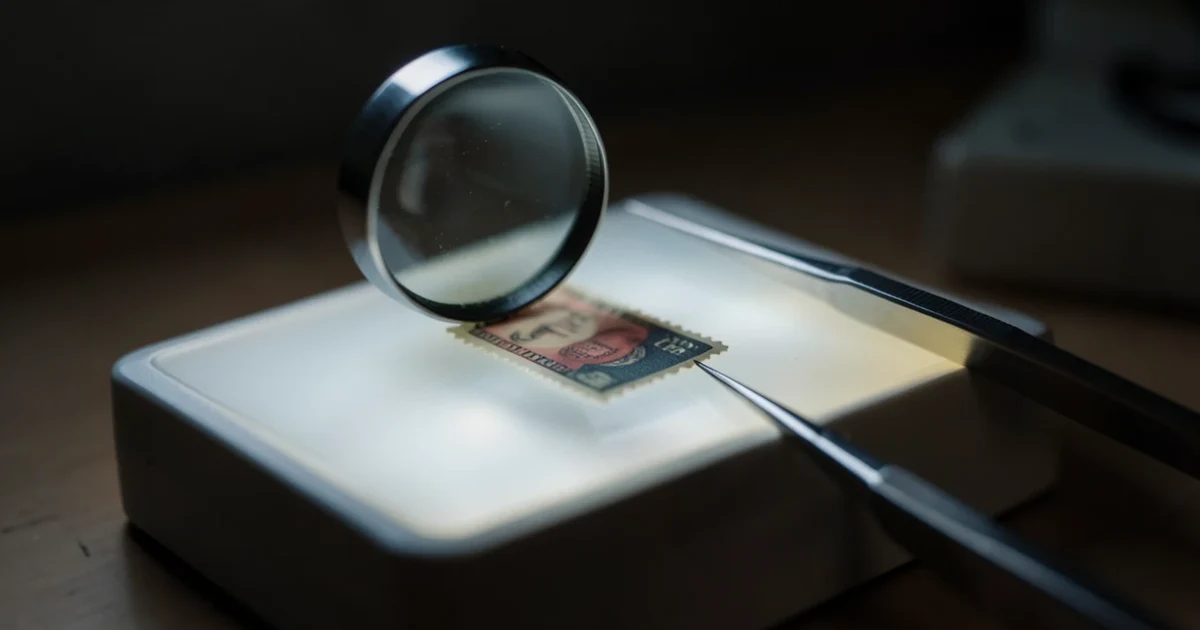
Philately has been forged since almost the beginning, because a small piece of printed paper with a large price is an obvious target.
The printing method catches most classic forgeries
The best single check, and it needs a fingertip.
Most nineteenth-century high-value stamps were engraved — intaglio — so the ink stands proud of the paper and you can feel it. The lines are sharp and vary in thickness.
Forgers overwhelmingly used lithography, because it is cheap. Lithographed ink is completely flat, and the line width is even.
A stamp that should be engraved and is flat is a forgery. That check disposes of a great many of the classic fakes in circulation.
Detail in printing methods.
The categories of dishonesty
Worth separating, because they need different responses.
Complete forgeries. The whole stamp printed by someone other than the postal authority. Some are crude; a few nineteenth-century forgers were very good and their work is itself collected.
Faked overprints. A genuine common stamp with an overprint added. This is the most profitable fraud in the hobby because the base stamp is real and only the ink is new — and overprints are frequently what carries the value.
Repairs. Tears closed, thins filled, perforations rebuilt, creases pressed out. Skilled work is genuinely hard to see without a light box.
Regumming. Gum applied to a used or hinged stamp to pass it as never hinged, which can multiply the price. Gum running over the perforation tips is a warning sign.
Reperforating. Trimming a stamp and adding new perforations to improve the centring. The tell is perforation holes that do not match the original gauge or spacing.
Faked cancels. Adding a desirable postmark, or removing one chemically to make a used stamp look mint.
Faked errors. Colours removed chemically to imitate a missing-colour error. This is why errors are the most heavily faked category of all.
What you can check yourself
- Printing method, by feel and under a lens.
- Perforation gauge, against the catalogue for that issue. A wrong gauge is conclusive.
- Watermark, likewise.
- Under UV, which reveals repairs, added gum and some inks.
- Held to light, which shows thins as bright patches and repairs as inconsistent paper.
- Measurements, since forgeries are frequently a fraction of a millimetre out.
When to get a certificate
Anything expensive. The threshold is a matter of judgement, but for anything running into hundreds it is not optional.
A certificate is an opinion from a recognised expertising body — the Royal Philatelic Society London, the Philatelic Foundation, the APS in the United States, and their equivalents elsewhere — confirming that the stamp is genuine and describing its condition.
Buying an expensive stamp without one means taking the seller's word on the single question that determines whether it is worth anything at all. A stamp with a good recent certificate is worth substantially more than the same stamp without one, and that difference is roughly the market pricing the risk.
Old certificates are worth less than new ones. Expertising standards have improved and a certificate from decades ago may not reflect current knowledge.
The proportionate view
Most stamps are not worth forging. If you are working through an inherited album of twentieth-century material, forgery is not your problem — the problem is that most of it is common.
Forgery becomes relevant exactly when a stamp appears to be valuable, which is the moment to stop guessing and get an opinion.
Reference forgeries are collected too
Worth knowing because it changes how you treat one you find.
The nineteenth-century forgers — Sperati, Fournier, de Thuin — are studied in their own right, and their work is catalogued and collected. A Sperati forgery can be worth more than the genuine stamp of the same issue.
So a forgery is not automatically worthless, and it is certainly not something to destroy. It should be marked as a forgery on the reverse in pencil, which is standard practice and prevents it being sold on as genuine later.
Topics referenced
Keep reading
- Do Not Soak That EnvelopeThe cover is frequently worth more than the stamp on it. Postmarks, routes and usages carry the value, and soaking destroys all of them.
- Where the Value Hides in Identical-Looking StampsTwo stamps from the same design can differ by three orders of magnitude. The difference is almost never visible in the design.
- Is My Stamp Collection Worth Anything?Usually a modest sum. Stamps were printed in the hundreds of millions, catalogue values are not selling prices, and condition decides most of what remains.