
Do Not Soak That Envelope
By IdentifyThese Editorial · Reviewed · 3 min read
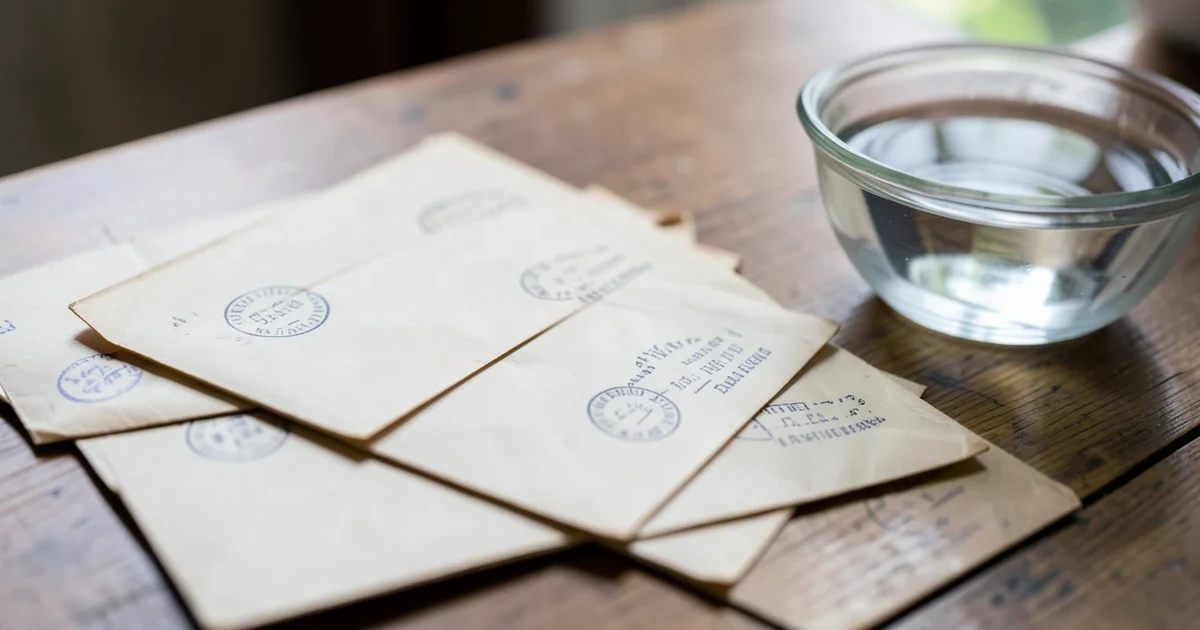
The instinct is to free the stamp from the paper. On anything old or interesting, the paper is the valuable part.
What a cover is worth
A cover is a whole envelope with its stamp, postmarks and any markings, and postal historians collect them for what the envelope records rather than what the stamp is.
Value sits in:
- Postmarks — the town, the date, the type of cancel. Small or short-lived post offices carry real premiums.
- Routing — transit and arrival marks showing how a letter travelled.
- Rate — whether the postage matches a documented rate for that weight, destination and period.
- Usage — a stamp used during a short window, or in an unusual way.
- Destination — mail to unusual places.
- Historical context — wartime censorship, occupation markings, disaster mail, ship or airmail routes.
A common stamp on an interesting cover is routinely worth many times the same stamp soaked off.
When soaking is fine
- Modern commemoratives off ordinary domestic mail
- Common definitives with unremarkable cancels
- Anything you have checked and established is common on both counts
If the envelope is plain, recent, and the cancel is an ordinary machine mark, soak away.
When to stop
Leave it on if any of these apply:
- Pre-1940 mail, and certainly pre-1900
- Any hand-struck cancel rather than a machine one
- Multiple stamps making up a rate
- Registered, airmail, censored or official markings
- Anything with a foreign destination or transit marks
- Postal stationery — where the stamp is printed onto the envelope, and cutting it out destroys the item entirely
- Revenue stamps on documents, where the document generally carries the value
If in doubt, leave it. The stamp will still be there next year.
How to soak, when you do
- Trim the paper to a small margin around the stamp. Do not cut the perforations.
- Float face up in cool water. Face up keeps ink off the design.
- Wait. The stamp releases on its own. Never rub or pull — a wet stamp tears with almost no force.
- Rinse briefly.
- Dry face down on kitchen paper, then press flat under light weight overnight.
What not to do
Do not soak coloured paper with anything else. Red and purple envelopes bleed and ruin everything in the water.
Do not soak stamps with coloured cancels — some inks are fugitive and dissolve.
Do not soak self-adhesives in water. They need a soak in a specialist solution or, more commonly, are left on paper deliberately.
Do not use warm water, which softens gum and paper faster than you can control.
Do not soak anything you have not identified. The whole point is that the decision comes first.
Postal stationery specifically
If the stamp design is printed onto the envelope or card rather than stuck on, that is postal stationery and it is a collected item in its own right. Cutting the design out — making a "cut square" — destroys most of its value.
The general principle
Everything in this subject rewards doing less. Do not clean, do not repair, do not regum, do not trim perforations, do not soak.
The reversible action is leaving it alone, and the value question is usually settled by identifying it properly first.
Drying and storing afterwards
Once a stamp is off and rinsed, dry it face down on plain kitchen paper, then press flat between sheets of blotting paper under a light weight overnight.
Do not dry on newspaper, which transfers ink, and do not use heat, which curls the paper and can set a curve permanently. A stamp dried badly is worth less than one left on the envelope.
Topics referenced
Keep reading
- Where the Value Hides in Identical-Looking StampsTwo stamps from the same design can differ by three orders of magnitude. The difference is almost never visible in the design.
- Is My Stamp Collection Worth Anything?Usually a modest sum. Stamps were printed in the hundreds of millions, catalogue values are not selling prices, and condition decides most of what remains.
- Forgeries, Fakes and Why Certificates ExistPrinting method catches most classic forgeries. Overprints, regumming and repairs need an expert, and any expensive stamp should carry a certificate.