
How Old Is This Tree, Without Cutting It Down
By IdentifyThese Editorial · · 3 min read
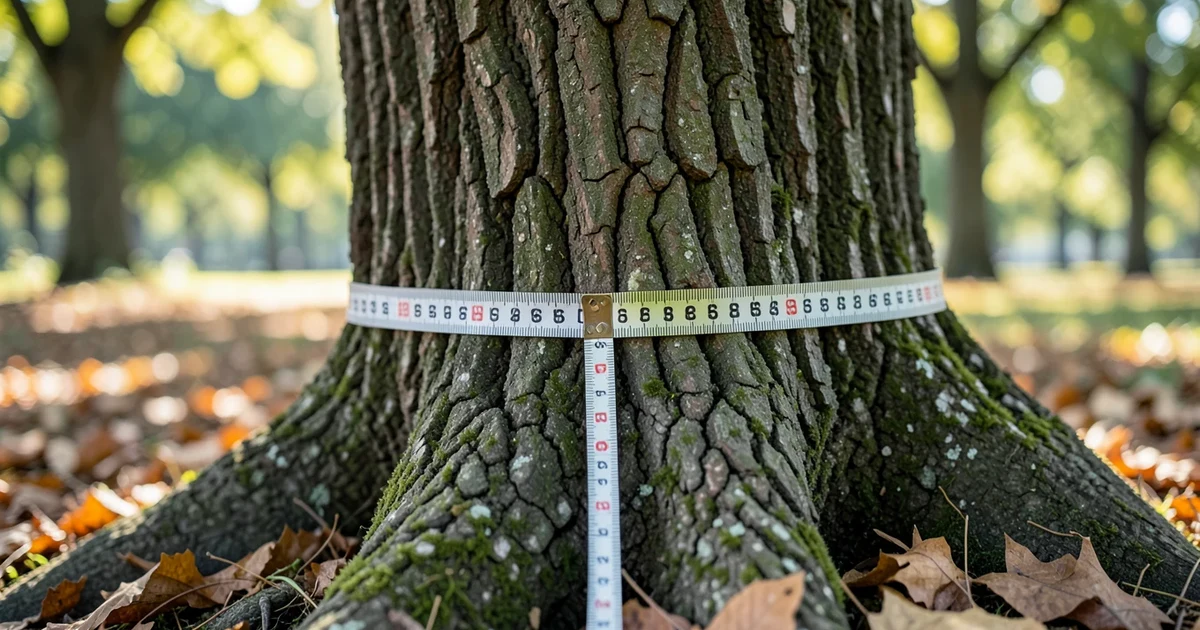
There is a method that gets you an estimate in two minutes with a tape measure, and it is genuinely useful as long as you know what it is doing and where it falls apart.
The method
- Measure the circumference of the trunk at 1.4 m above the ground — breast height, the forestry standard. Measure the circumference, the distance around, not the width.
- Divide by π (3.14) to get the diameter in the same units.
- Multiply the diameter in inches by the species growth factor below.
The result is an age in years.
Growth factors
These are the numbers foresters and arborists use, expressed per inch of diameter.
| Species | Factor | 24 in diameter implies |
|---|---|---|
| Quaking aspen | 2.0 | 48 years |
| Silver maple | 3.0 | 72 years |
| American sycamore | 4.0 | 96 years |
| Red maple | 4.5 | 108 years |
| Black walnut | 4.5 | 108 years |
| River birch | 3.5 | 84 years |
| Red oak | 4.0 | 96 years |
| American beech | 6.0 | 144 years |
| White oak | 5.0 | 120 years |
| Sugar maple | 5.5 | 132 years |
| American elm | 4.0 | 96 years |
| White pine | 5.0 | 120 years |
| Shagbark hickory | 7.5 | 180 years |
| Flowering dogwood | 7.0 | 168 years |
The pattern is the useful part: fast pioneer species have low factors, slow-growing shade-tolerant hardwoods have high ones. Aspen and hickory differ by nearly four times.
Which means the method depends entirely on identifying the tree first. A 24-inch trunk is 48 years old or 180, depending on what it is. If you are not certain, start with bark or leaf shape.
Where it goes wrong
The factors were derived from open-grown trees in average conditions, and every departure from that introduces error in a predictable direction.
- Forest-grown trees read too young. Competing for light, they put on far less diameter per year. A crowded woodland oak can be twice the age the tape suggests.
- Street and lawn trees read too old. Watered, fertilised and uncrowded, they widen fast.
- Stress compresses rings. Drought years, root damage, construction, disease — all narrow the rings without narrowing the estimate.
- Multi-stemmed trees do not work at all. The method assumes one trunk.
- Buttressed or fluted trunks — beech, hornbeam, old sycamores — inflate the circumference. Measure above the flare if you can.
Twenty per cent either way is a fair expectation for a well-identified open-grown tree. Outside those conditions, treat it as an order of magnitude rather than a number.
Doing better
Increment boring. A hollow bit extracts a pencil-thin core across the radius; the rings are counted under magnification. The tree seals the wound. This is the accurate method and it is not something to attempt casually — it needs the right tool and a clean technique. Arborists and university extension services do it.
Known planting dates. Cemeteries, campuses, parks and estates often have records. A single dated tree of the same species and situation calibrates every other tree on the site far better than any table.
Counting whorls on conifers. Pines put out one whorl of branches per year. On a young white pine you can count them up the trunk and get an exact age. It stops working once the lower branches self-prune.
Stumps nearby. If a neighbouring tree of the same species has been felled, count its rings and measure its diameter. That gives you a local growth factor worth far more than the table.
What the number is for
Age estimates matter for heritage tree applications, for planning removals, and for the ordinary satisfaction of knowing whether the oak was there before the house.
They are also how people discover that a very large tree is not necessarily old and a modest one can be ancient. A hedgerow hawthorn the width of your leg may predate everything around it. The tape measure is a starting point, not a verdict.
Species referenced
Start here: opposite or alternate?
Look at where the leaves join the twig. Are they in matched pairs directly across from each other, or staggered one after another? The vast majority of trees are alternate, so finding an opposite tree removes almost everything else in one step.
In North America, opposite-leaved trees are remembered as MAD Cap Horse: Maple, Ash, Dogwood, Caprifoliaceae (viburnums and elders), and Horse chestnut. That is very nearly the whole list.
Check partway along a healthy twig rather than at the tip, where crowding can make alternate leaves look paired. And check more than one twig.
Keep reading
- Identifying a Tree by Its BarkBark changes with age, which is why most bark guides fail. Work with texture, direction and colour under the surface rather than matching a photograph.
- Leaf Shape, Properly: Lobed, Toothed, EntireEvery tree key asks whether the margin is lobed, toothed or entire, and whether the leaf is simple or compound. Here is what those four words actually mean.
- Opposite or Alternate? The Question That Halves the AnswerOnly a handful of North American trees have opposite leaves. Checking this first eliminates most species in seconds — here is how to read it, and the mnemonic that lists them.