
Identifying a Tree by Its Bark
By IdentifyThese Editorial · Reviewed · 3 min read
Bark identification has a reputation for being unreliable, and the reason is almost always the same mistake: comparing a photograph of a mature trunk with the sapling in front of you.
Bark is not a fixed property of a species. It is what happens to a surface that has to keep expanding, and it changes character as the trunk widens. A smooth young red oak and a deeply-ridged old one are the same tree wearing two different textures.
Work with that rather than against it and bark becomes one of the more dependable characters available — particularly in winter, when it is one of the few left.
Start with texture, not colour
Colour shifts with moisture, light, lichen and algae. A wet trunk is darker, a north face is greener, and a photograph taken in different light is a different colour. Texture is stable.
There are roughly six textures worth learning:
| Texture | What it looks like | Examples |
|---|---|---|
| Smooth | Unbroken, taut, often grey | American beech, young maples, hornbeam |
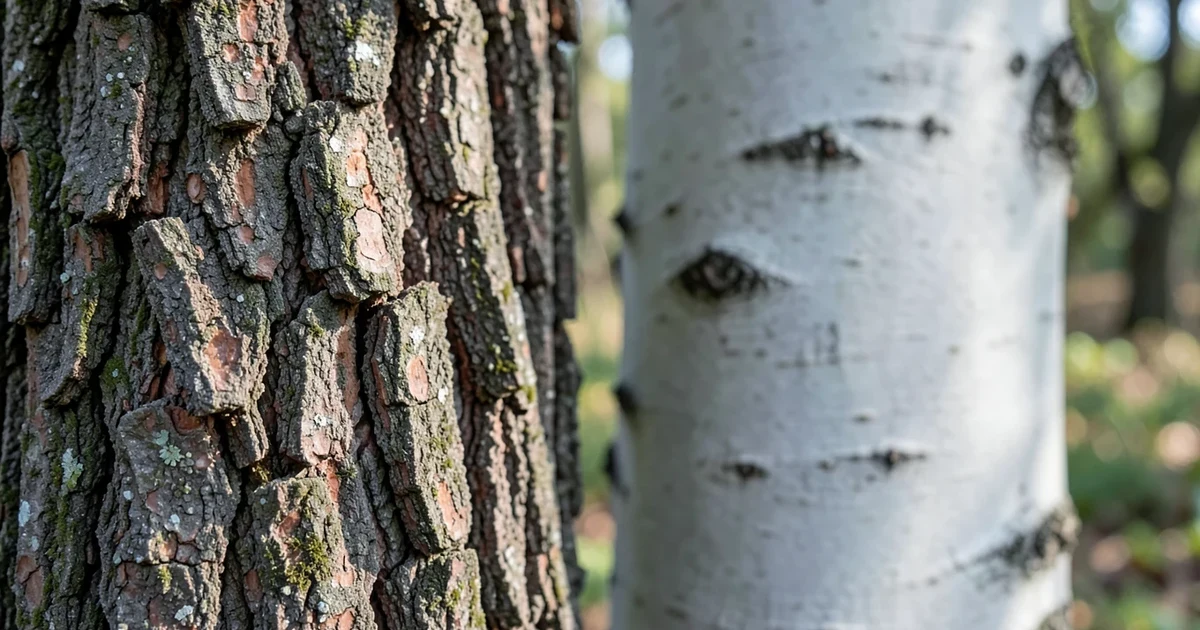
| Peeling in sheets | Papery, horizontal, curling | Paper birch, river birch |
| Plated | Irregular plates with gaps between | Black cherry, older pines |
| Furrowed | Vertical ridges and valleys | Oaks, ashes, black walnut |
| Diamond-patterned | Furrows crossing into a net | White ash, some oaks |
| Flaking to a pale under-layer | Camouflage-like patches | American sycamore, London plane |
That last one is the easiest tree in the book. If the upper trunk looks white and the bark is coming off in jigsaw pieces, it is a sycamore, in winter or summer.
Then direction
Once you have texture, look at how the pattern runs.
- Vertical ridges, unbroken up the trunk — oaks, ashes.
- Vertical but interrupted into short blocks — black walnut, some hickories.
- Horizontal marks, lines or lenticels — birches, cherries. Black cherry's horizontal lenticels survive into maturity even after the surface turns plated and dark.
- Interlacing into a diamond net — white ash is the standard example, and it is the character most people find easiest to recognise once shown.
Look into the furrow, not at the ridge
The ridge tops are weathered, colonised and unrepresentative. The inside of a furrow is protected, and it is where the useful colour lives.
- Northern red oak has pale, flat-topped ridges with distinctly darker furrows — often described as ski tracks running up the trunk. Once you see it, it is unmistakable.
- White oak is paler overall, with looser, more scaly ridges and less contrast.
- Black walnut is dark chocolate in the furrow, with tight ridges that feel sharp.
Scratching a small area of outer bark on a twig — not the trunk — gives you the inner bark colour, which is diagnostic in a few cases and worth the look.
Smell counts
Not a joke, and it works:
- Black cherry — scrape a twig: a distinctive bitter almond, sharp and unpleasant.
- Black birch and yellow birch — wintergreen, strongly.
- Tree of heaven — a broken twig smells rancid, like burnt peanut butter. This is the fastest way to confirm one, and it is a widely-spread invasive worth being able to name.
- Sassafras — root beer.
Age changes everything
Before you commit, ask how old the trunk is.
| Species | Young | Mature |
|---|---|---|
| Red maple | Smooth, pale grey | Shaggy, plated, dark |
| American beech | Smooth grey | Smooth grey — it barely changes, which is itself diagnostic |
| Red oak | Smooth, striped | Ridged with pale ski tracks |
| Shagbark hickory | Tight | Long curling plates, unmistakable |
Beech is the useful case here. Most trees roughen with age; beech stays smooth, which is why old beeches collect carved initials and other species do not.
What bark cannot do
Bark rarely separates closely related species — red oak from black oak, sugar maple from Norway maple. For those you want the leaves, the buds or the twigs.
The fastest structural check available at any season is arrangement, and it eliminates most of the tree list in one look: opposite or alternate. Combined with bark, and with the other winter characters in identifying trees in winter, it will get you to a short list on a leafless tree in about a minute.
Species referenced
Start here: opposite or alternate?
Look at where the leaves join the twig. Are they in matched pairs directly across from each other, or staggered one after another? The vast majority of trees are alternate, so finding an opposite tree removes almost everything else in one step.
In North America, opposite-leaved trees are remembered as MAD Cap Horse: Maple, Ash, Dogwood, Caprifoliaceae (viburnums and elders), and Horse chestnut. That is very nearly the whole list.
Check partway along a healthy twig rather than at the tip, where crowding can make alternate leaves look paired. And check more than one twig.
Keep reading
- Identifying Trees in Winter, With No Leaves at AllBark, buds, twigs and last year's fruit on the ground. Winter identification is not harder than summer — it just uses different characters, several of them more reliable.
- Opposite or Alternate? The Question That Halves the AnswerOnly a handful of North American trees have opposite leaves. Checking this first eliminates most species in seconds — here is how to read it, and the mnemonic that lists them.
- Identifying a Tree From a Photograph: What Actually WorksPhoto identification succeeds and fails in predictable ways. Which four photographs to take, and why a picture of the whole tree is the least useful of them.