

Identifying a Tree From a Photograph: What Actually Works
By IdentifyThese Editorial · · 3 min read
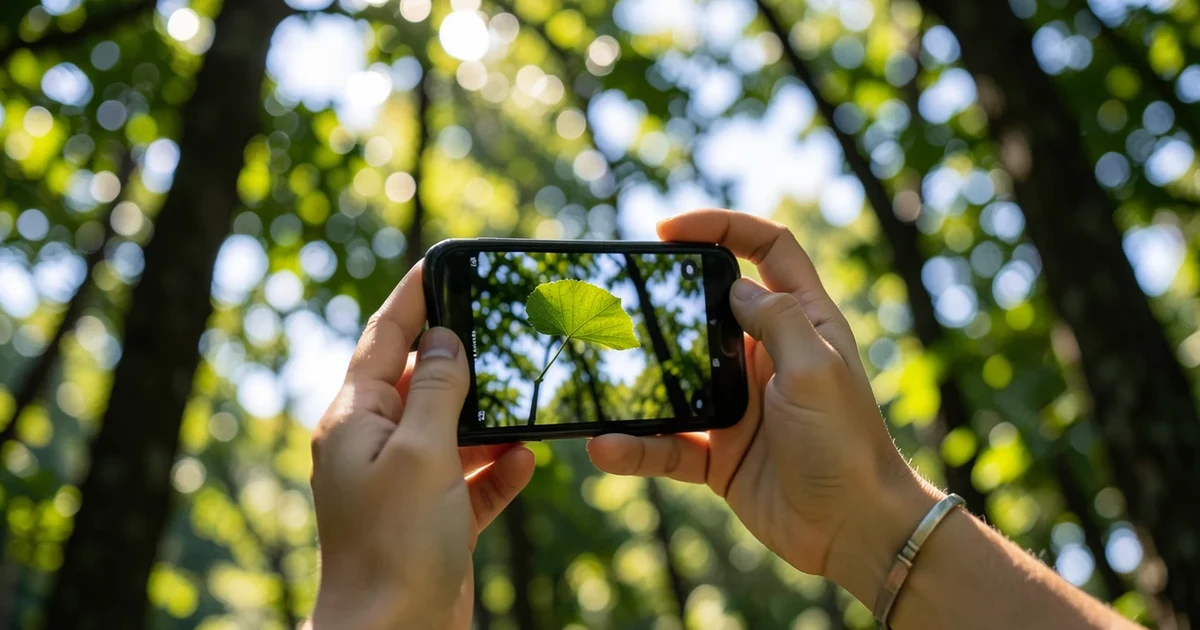
Photo identification works better than sceptics claim and worse than the marketing implies, and the difference between the two outcomes is almost entirely the photograph.
Most failed identifications are failures of what got captured, not of whoever was looking at it.
The four photographs
If you can only take one, take the first.
1. A single leaf, flat, front-lit. Pick a typical mid-crown leaf rather than a giant shade leaf or a stunted one. Lay it on something plain — paving, a notebook, your hand. Include the whole stalk down to where it joins the twig, because that is where the bud is and the bud is what settles simple versus compound. Shoot square-on, not at an angle.
Do not photograph a leaf backlit against the sky. It is the most common tree photograph taken and it throws away the surface texture, the true colour and usually the margin.
2. The twig, with buds and arrangement. Frame 15–20 cm of twig showing at least two nodes. Whether the leaves and buds are opposite or alternate is the single most eliminating character available and it is invisible in a leaf close-up. Opposite or alternate explains why it does so much work.
3. Bark at chest height, in flat light. Fill the frame with about 30 cm of trunk. Include something for scale. Overcast light is better than sun, which blows out the ridges and blackens the furrows.
4. Whatever it is carrying. Flowers, fruit, cones, nuts, seed pods, catkins. These are the most species-specific structures on the tree and they are seasonal, so if one is present, photograph it.
The whole-tree silhouette is worth taking last. It confirms a candidate and rarely produces one.
What a photograph cannot capture
This is where apps and forums both fail, and knowing the list tells you when to distrust an answer.
- Sap colour. Sugar maple and Norway maple are separated instantly by snapping a leaf stalk — Norway bleeds milky white, sugar runs clear. No photograph shows this.
- Smell. Black cherry's bitter almond, black birch's wintergreen, tree of heaven's rancid peanut. All decisive, none photographable.
- Texture under a thumb. Whether a scale is keeled, whether a leaf underside is downy or smooth, whether bark is corky or hard.
- Scale. A leaf without a reference object could be 5 cm or 25. Put a coin or a hand in the frame.
- Which tree it came from. A leaf photographed on the ground under a tree is frequently from a different tree.
Where apps are reliable, and where they are not
They are good at distinctive, widely-photographed species — ginkgo, sycamore, tulip tree, sassafras, white pine. Anything with a shape nothing else has.
They are unreliable in exactly the cases where you most want help:
- Closely related pairs — red oak against black oak, sugar against Norway maple, white against swamp white oak.
- Cultivars and street trees, which are over-represented in cities and under-represented in training data.
- Anything outside its native range, where the app's location prior works against you.
- Juvenile foliage, which frequently looks nothing like the adult.
Treat a confident app answer on a similar-species pair as a hypothesis. Then check it against a character the photograph could not have contained — the sap, the smell, the bud, the twig.
Getting a useful answer from a person
If you are asking someone, give them what a key needs rather than what looks nice:
- Where it is, to the state or county. Range eliminates more than any leaf character.
- Whether it was planted or wild. A street tree is drawn from a different, much smaller list.
- Rough size and trunk diameter.
- The month, so seasonal features can be interpreted.
- Whether the leaves are opposite or alternate, if you looked.
That last one, supplied as text, is often worth more than every photograph attached.
When there are no leaves
The four-photograph list changes: buds, twigs, bark, persistent fruit, and the overall branching form. Identifying trees in winter covers what to look at, and it is a more tractable problem than it sounds — winter buds are highly distinctive and there are fewer characters competing for your attention.
Species referenced
Start here: opposite or alternate?
Look at where the leaves join the twig. Are they in matched pairs directly across from each other, or staggered one after another? The vast majority of trees are alternate, so finding an opposite tree removes almost everything else in one step.
In North America, opposite-leaved trees are remembered as MAD Cap Horse: Maple, Ash, Dogwood, Caprifoliaceae (viburnums and elders), and Horse chestnut. That is very nearly the whole list.
Check partway along a healthy twig rather than at the tip, where crowding can make alternate leaves look paired. And check more than one twig.
Keep reading
- Leaf Shape, Properly: Lobed, Toothed, EntireEvery tree key asks whether the margin is lobed, toothed or entire, and whether the leaf is simple or compound. Here is what those four words actually mean.
- Identifying a Tree by Its BarkBark changes with age, which is why most bark guides fail. Work with texture, direction and colour under the surface rather than matching a photograph.
- Identifying Trees in Winter, With No Leaves at AllBark, buds, twigs and last year's fruit on the ground. Winter identification is not harder than summer — it just uses different characters, several of them more reliable.