

Calico, Tortie, Tabby and Tuxedo Are Not Breeds
By IdentifyThese Editorial · Reviewed · 3 min read
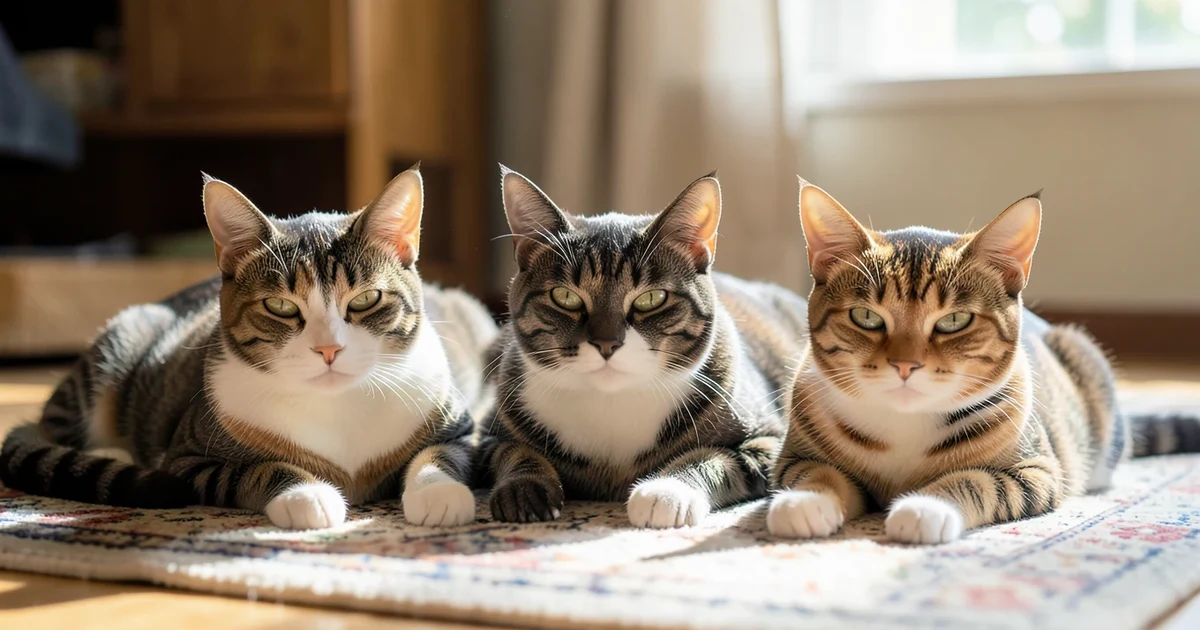
Each of these words describes how colour is arranged on a cat. None of them describes ancestry, and ancestry is what a breed is.
What each one means
Tabby — the striped, swirled, spotted or ticked pattern, and the ancestral one. Every domestic cat carries tabby genes; solid-coloured cats have them masked. Four varieties:
- Mackerel — narrow vertical stripes, the classic "tiger" cat
- Classic — wide swirls and a bullseye on the flank
- Spotted — broken stripes forming spots
- Ticked — no body pattern at all, just banded hairs
Every tabby has an M on the forehead. It comes with the pattern, not with any breed.
Tortoiseshell — orange and black mingled together, with little or no white. Sometimes called a tortie.
Calico — orange, black and white in distinct patches. In Britain, tortoiseshell-and-white.
Tuxedo — black with white on the chest, face and paws. A bicolour arrangement.
Colourpoint — dark face, ears, legs and tail on a pale body. This one is a bit different: it comes from a temperature-sensitive enzyme that only produces pigment below normal body temperature, so colour develops on the cooler extremities. It appears in Siamese, Ragdoll, Birman, Himalayan and plenty of moggies.
Why calicos are female
The gene for orange sits on the X chromosome.
A cat with two X chromosomes can carry orange on one and non-orange on the other. Early in development each cell randomly switches one X off, so patches of skin express different colours — which is what produces the patchwork.
A cat with one X gets one or the other, not both. So tortoiseshells and calicos are nearly always female. Males occur at roughly one in three thousand, through an extra X chromosome, and they are almost always sterile.
The same mechanism means no two calicos are alike, even littermates, because the switching is random.
What patterns do not tell you
- Not breed. A calico can be a domestic shorthair, a Persian, a Maine Coon or a British Shorthair.
- Not temperament. "Tortitude" — the idea that tortoiseshells are feistier — is folklore. Studies looking for coat-personality links have found weak and inconsistent effects, and expectation probably explains most of it.
- Not health, with two narrow exceptions: white cats with blue eyes have a high rate of congenital deafness, and white cats sunburn and are prone to skin cancer on the ear tips.
What tells you the breed instead
Build, coat texture and head shape — the characters the identification key asks about, and the argument in most cats are not a breed.
A ticked tabby, for what it is worth, is the one pattern that does narrow things: it is characteristic of the Abyssinian, where the whole body is flecked with no stripes at all. But ticked moggies exist and are common, so it narrows rather than decides.
The naming that causes it
Shelters and vets write "domestic shorthair — calico" on a chart, which reads like a breed and a variant. It is a species-level description and a colour note. The cat is a moggy, and calico is what colour it happens to be.
The white spotting gene, which explains most of the rest
Tuxedo, bicolour, van pattern and "mittens" are all the same gene expressed to different degrees.
White spotting removes pigment from areas of the coat, and how much depends on the dose. A little gives a white chest and paws — the tuxedo. More gives a bicolour. A great deal leaves colour only on the head and tail, which is the van pattern.
It also explains why white markings are so often symmetrical on the chest and feet: pigment cells migrate from the back during development, so the areas furthest from the spine are the first to be left uncoloured.
None of which is a breed. It is one gene, in every breed and in most moggies.
Breeds referenced
Keep reading
- Most Cats Are Not a BreedAround nine in ten cats have no breed at all. Calico, tabby and tortoiseshell are coat patterns, and a domestic shorthair is the correct answer, not a failure.
- Is It a Maine Coon, or Just a Big Fluffy Cat?Size is not the test. A Maine Coon has a squared muzzle and a rectangular frame, and most large fluffy cats have neither.
- Your Grey Cat Is Probably Not a Russian BlueThree grey breeds exist and all three are uncommon. The eye colour and the coat texture separate them from the grey moggy, which is what most grey cats are.