
Your Grey Cat Is Probably Not a Russian Blue
By IdentifyThese Editorial · Reviewed · 3 min read
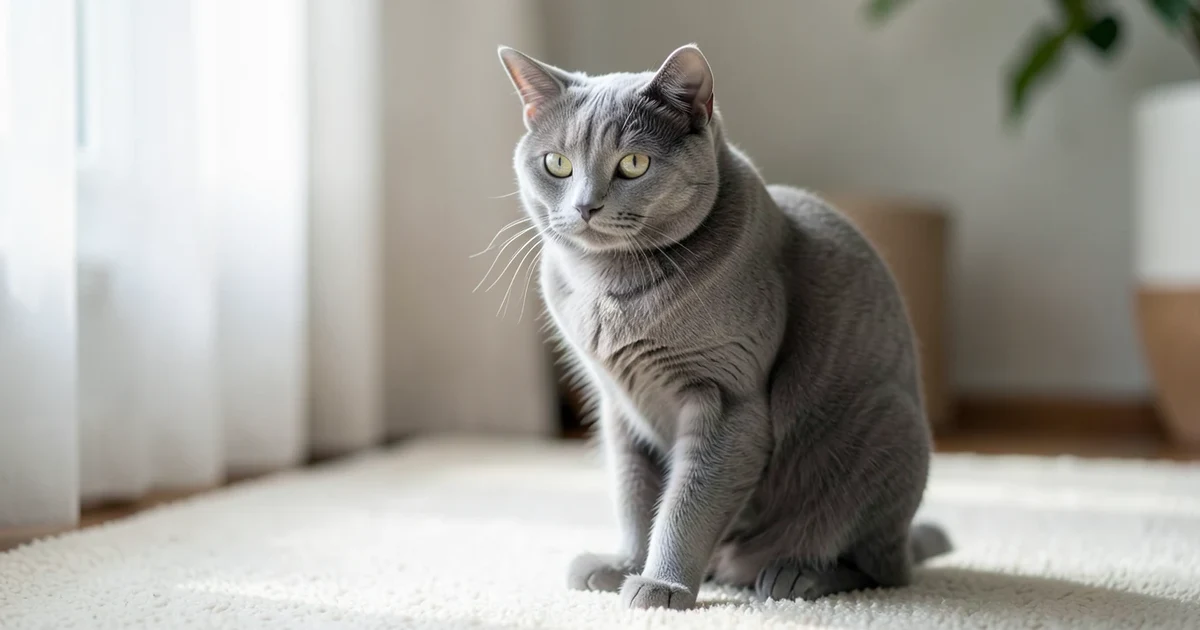
Grey is a common colour in cats with no breed at all. Three breeds are grey by definition, and all three are considerably rarer than the number of cats called by their names.
Start with the eyes
Vivid green — possibly a Russian Blue. Always green, in every adult.
Copper, gold or orange — possibly a British Shorthair, or far more likely a domestic shorthair.
Green in a heart-shaped face — possibly a Korat, which is genuinely rare outside Thailand.
A grey cat with copper eyes is not a Russian Blue, whatever else is true of it.
Then the coat
This is where it becomes decisive, and it needs a hand rather than a photograph.
Russian Blue — a dense double coat with silver-tipped guard hairs, which produces a visible shimmer as the cat moves. The coat stands out from the body on a slender frame.
British Shorthair — a very dense, crisp, plush coat that stands away from the body and springs back when you stroke against it. It feels like upholstery. No silver tipping.
Korat — a single coat, no undercoat, lying close, with no silver tipping. It feels quite different from either.
Domestic shorthair — an ordinary coat, lying flat, no shimmer and no spring.
Then the build
| Russian Blue | British Shorthair | Domestic shorthair | |
|---|---|---|---|
| Eyes | Vivid green | Copper or gold | Any |
| Build | Slender, fine-boned | Cobby, heavy, short-legged | Ordinary |
| Head | Wedge, flat-topped | Broad and round, full cheeks | Ordinary |
| Coat | Silver-tipped, shimmering | Dense plush, springs back | Flat |
| Weight | 3–5.5 kg | 4–8 kg | 3.5–6 kg |
The British Shorthair's cheeks are the other giveaway — mature males in particular develop very full jowls that give the round-faced look the breed is known for.
Why the confusion is so persistent
Grey — properly "blue" in cat terminology — is produced by a dilution gene acting on black, and it is common in the general cat population. It has nothing to do with breed.
So there are a great many grey moggies, three grey breeds, and an obvious name for people to reach for. The Russian Blue gets the credit because it is the best known.
What settles it in practice
Papers. A breed is a documented pedigree, and a Russian Blue from a registered breeder comes with registration. Without documentation, a grey cat with green eyes is a grey cat with green eyes.
That is not a technicality. It is the whole definition — the reasoning in most cats are not a breed.
A note on the Russian Blue's reputation
It is one of the healthier pedigree breeds, with no strong breed-specific predispositions — unusual enough to be worth stating, given how many pages on this section carry a health warning.
It is also genuinely reserved with strangers, which is worth knowing before acquiring one expecting a sociable cat. The affection is real and it goes to one household.
The other grey option people miss
Chartreux — a French breed, blue-grey, with copper eyes and a dense water-repellent coat over a sturdy body. Genuinely rare outside France, and frequently claimed for grey moggies with round faces.
It sits between the British Shorthair and the Russian Blue in build, which is why it defeats the simple version of the test above. If you have a grey cat, a rounded face, copper eyes and papers from a French breeder, that is a Chartreux. Without the papers, it is a grey cat.
The naming
"Blue" in cat terminology means grey, which trips up almost everyone the first time. A blue cat is grey; a blue-eyed cat has blue eyes; a blue point has grey points. The words are not related.
Breeds referenced
Keep reading
- Calico, Tortie, Tabby and Tuxedo Are Not BreedsThey describe how the colour is arranged, and they occur across many breeds and in most cats of none. Here is what each one actually means.
- Most Cats Are Not a BreedAround nine in ten cats have no breed at all. Calico, tabby and tortoiseshell are coat patterns, and a domestic shorthair is the correct answer, not a failure.
- Is It a Maine Coon, or Just a Big Fluffy Cat?Size is not the test. A Maine Coon has a squared muzzle and a rectangular frame, and most large fluffy cats have neither.