
Pointed and Blue-Eyed: Siamese, Ragdoll or Birman?
By IdentifyThese Editorial · Reviewed · 3 min read
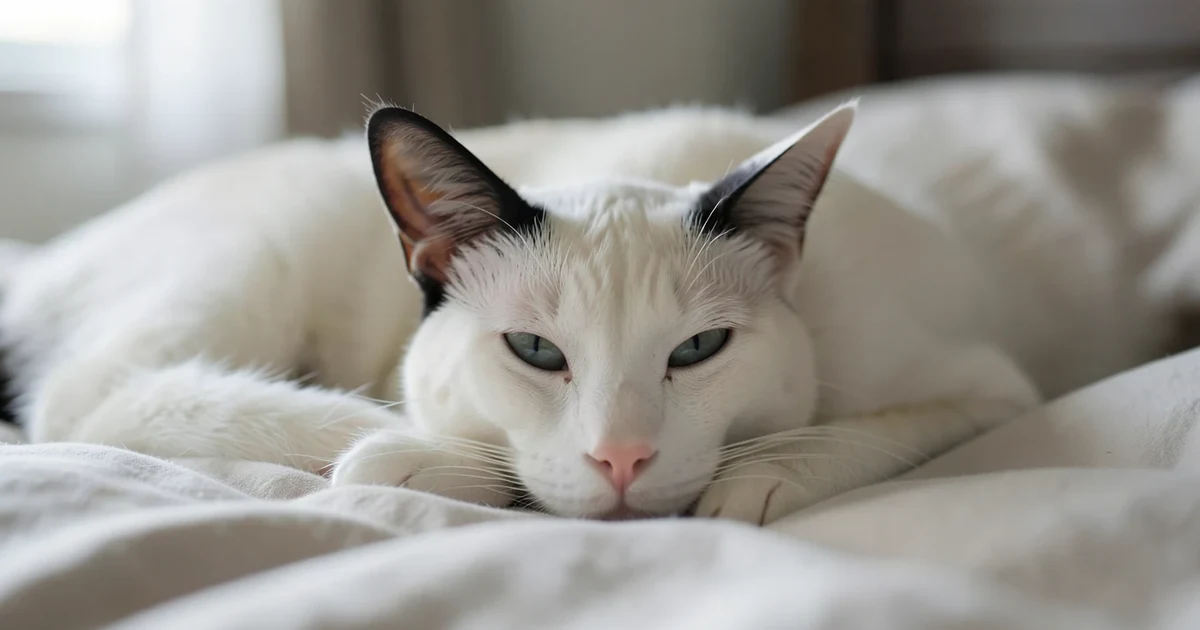
The colourpoint pattern — pale body, dark face, ears, legs and tail — plus blue eyes is shared by several breeds and by a good number of cats with no breed at all.
Three characters separate the common ones.
The mechanism, first
Colourpoint comes from a temperature-sensitive variant of the enzyme that makes pigment. It only works below normal body temperature, so colour develops where the cat is coolest — the extremities.
Two consequences worth knowing:
- Kittens are born white and darken over the first weeks, as the extremities cool.
- Cats living in cold rooms darken overall, and old cats often darken as circulation changes. It is not a health sign.
The same gene produces the blue eyes, which is why the two always travel together.
Telling the breeds apart
| Size | Coat | Feet | Head | |
|---|---|---|---|---|
| Siamese | Small, 2.5–5 kg | Short | Coloured | Long wedge, very large ears |
| Ragdoll | Large, 4.5–9 kg | Semi-long, silky | Often white mittens | Modified wedge, moderate ears |
| Birman | Medium | Semi-long | White gloves, symmetrical | Rounded, Roman nose |
| Himalayan | Medium | Very long | Coloured | Flat-faced |
| Balinese | Small | Semi-long, plumed tail | Coloured | Long wedge, large ears |
Size settles most of it. A small, slim, short-coated pointed cat with enormous ears is a Siamese. A large heavy semi-longhaired one is a Ragdoll.
The feet settle the Birman. It has white gloves on all four feet, symmetrical, with the back ones running up the hock in a point called a gauntlet. Ragdolls may be mitted, but the Birman's gloves are part of the standard and unusually even.
The face settles the Himalayan. It is a Persian in colourpoint, with the flat brachycephalic face and everything that comes with it.
The Siamese has changed
Worth knowing because people compare a cat with a photograph and get confused by which era it came from.
Modern show Siamese are extreme: a very long straight wedge head, enormous ears, a tubular body, fine bone.
Traditional or "applehead" Siamese are the older type — a rounder head, smaller ears, a substantially heavier body. They are the same breed and they look quite different.
A pointed cat with a rounded head is not necessarily not a Siamese; it may be a traditional one. Or, much more likely, a moggy.
The moggy option
Colourpoint appears in domestic cats without any pedigree, particularly in areas where Siamese were common a few generations back. A pointed cat with an ordinary build and no papers is most probably a domestic shorthair — which is the general case made in most cats are not a breed.
Health worth knowing
Ragdolls carry a well-documented hypertrophic cardiomyopathy mutation with a breed-specific genetic test. Ask any breeder for the result.
Siamese and Orientals share predispositions to progressive retinal atrophy, amyloidosis and asthma.
Himalayans, being Persians, carry the brachycephalic breathing, tear-duct and dental problems that follow from the face shape.
The one people forget
The Oriental Shorthair is a Siamese in every colour except pointed. Identical build, identical enormous ears, usually green eyes. If you are looking at what seems like a Siamese in solid black or tabby, that is what it is.
Why the eyes are blue
The same gene, and it is worth understanding because it explains why every pointed cat has blue eyes and no pointed cat has green ones.
The colourpoint gene is a variant in the tyrosinase enzyme, which produces melanin. The variant only works below normal body temperature — hence the pattern — and the eye is warm throughout, so the iris produces essentially no pigment at all.
Blue eyes in a pointed cat are therefore not a separate trait being selected for. They come with the pattern, unavoidably, and a pointed cat with green or gold eyes does not exist.
Breeds referenced
Keep reading
- The Scottish Fold's Ears and What They CostThe mutation that folds the ear malforms cartilage everywhere else too. Every cat with folded ears develops painful degenerative joint disease.
- Calico, Tortie, Tabby and Tuxedo Are Not BreedsThey describe how the colour is arranged, and they occur across many breeds and in most cats of none. Here is what each one actually means.
- Your Grey Cat Is Probably Not a Russian BlueThree grey breeds exist and all three are uncommon. The eye colour and the coat texture separate them from the grey moggy, which is what most grey cats are.