
Is It a Maine Coon, or Just a Big Fluffy Cat?
By IdentifyThese Editorial · Reviewed · 3 min read
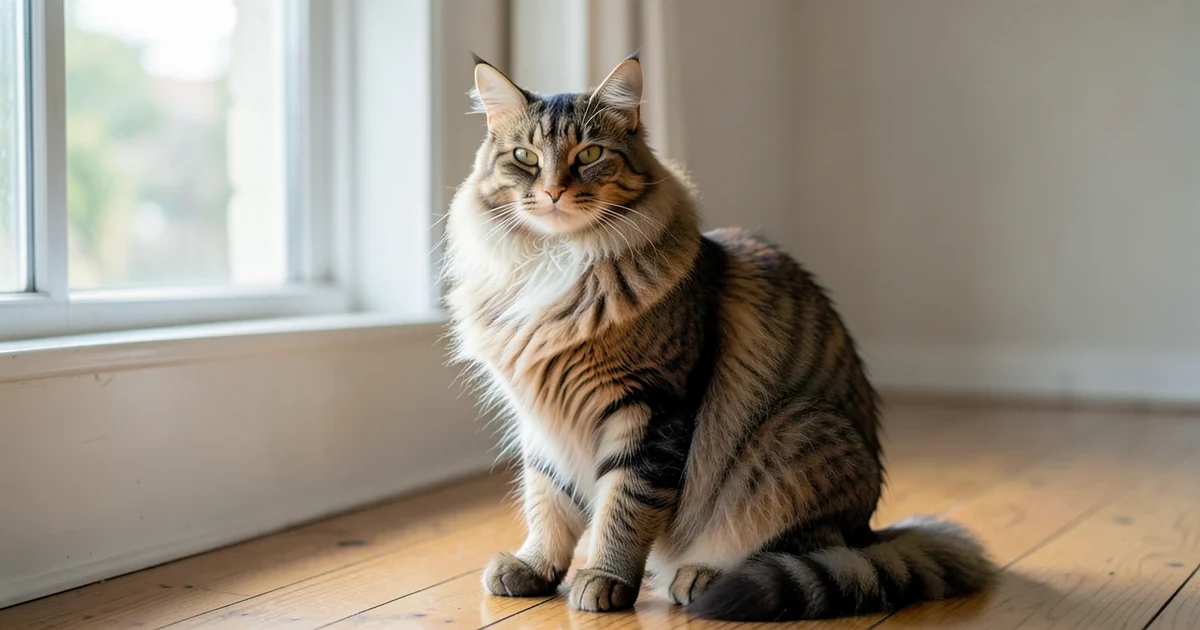
More cats get called Maine Coons than are Maine Coons, and it is almost always a large domestic longhair being promoted.
Size is the reason, and size is the weakest character available.
The muzzle is the test
A Maine Coon has a squared, blocky muzzle. Looked at head-on the muzzle is a distinct box, set off from the cheeks, with a strong square chin lining up beneath the nose.
A domestic longhair has a rounded face that tapers gently. There is no box.
This is the single most reliable character and it works on a photograph.
The frame
Rectangular. A Maine Coon is long — long body, long tail, substantial rectangular outline — with heavy boning and a broad chest. It should look like it is built out of timber.
A large domestic longhair is a normal cat shape that happens to be big, with lighter boning and a rounder silhouette.
The other characters
| Maine Coon | Domestic longhair | |
|---|---|---|
| Muzzle | Squared, blocky | Rounded, tapering |
| Frame | Long, rectangular, heavy bone | Ordinary cat shape |
| Ears | Large, set high and wide, usually lynx-tipped | Ordinary size |
| Coat | Shaggy and uneven — short on the shoulders, long on the flanks | Even, often seasonal |
| Tail | Long, wide, fully plumed | Plumed, usually shorter |
| Maturity | Slow — full size at three to five years | Two years |
The uneven coat is a good confirming character. A Maine Coon's coat is short over the shoulders and lengthens dramatically down the flanks and belly, with a ruff at the front. A domestic longhair's is more uniform.
The other two big longhairs
If it does have the frame, there are three breeds it could be, and the head separates them.
Maine Coon — squared muzzle, and a concave dip in the profile between brow and nose.
Norwegian Forest Cat — a straight profile, no dip at all, running from the brow to the tip of the nose in one line. Triangular head.
Siberian — round. Round head, round eyes, round paws, barrel body. No straight lines anywhere.
Straight profile, squared muzzle, or all curves. That is the whole distinction and it holds up.
Why it matters beyond bragging
Health screening. Maine Coons carry a well-documented hypertrophic cardiomyopathy mutation with a genetic test, plus hip dysplasia and spinal muscular atrophy. If you have a pedigree Maine Coon, those are the questions for the breeder and the vet. If you have a domestic longhair, they are not your breed's problems.
Buying one. "Maine Coon mix" from a private seller usually means a large fluffy cat of unknown ancestry, at a pedigree price. A real Maine Coon comes with registration papers and test results.
The honest version
Most large fluffy cats are not a breed at all, and a domestic longhair is a fine thing to have. It is also, statistically, a healthier one — the breeds carry concentrated versions of problems that mixed cats mostly avoid.
If you want to check yours: look at the muzzle, front-on, and ask whether it is a box or a curve.
Polydactyly, which is worth knowing about
A substantial proportion of early Maine Coons had extra toes, and the trait persists in some lines.
It is harmless, it was probably selected for on working ships and farms because the wider paw is an advantage in snow, and it was bred out of show lines because the standard excluded it. Some registries now accept polydactyl Maine Coons again.
An extra-toed large longhaired cat is therefore slightly more likely to be a Maine Coon than the general population — but it is a hint rather than a test, since polydactyly occurs in moggies too and is particularly common in cats from parts of New England and eastern Canada.
Breeds referenced
Keep reading
- Most Cats Are Not a BreedAround nine in ten cats have no breed at all. Calico, tabby and tortoiseshell are coat patterns, and a domestic shorthair is the correct answer, not a failure.
- Your Grey Cat Is Probably Not a Russian BlueThree grey breeds exist and all three are uncommon. The eye colour and the coat texture separate them from the grey moggy, which is what most grey cats are.
- Calico, Tortie, Tabby and Tuxedo Are Not BreedsThey describe how the colour is arranged, and they occur across many breeds and in most cats of none. Here is what each one actually means.