
Wild Mushrooms Are Cooked, Not Raw
By IdentifyThese Editorial · · 3 min read
Two things are true at once and they get conflated constantly.
Several well-known edible mushrooms are toxic raw and safe cooked. Cooking is a genuine and necessary step.
Cooking does nothing for the mushrooms that kill people. Amatoxins survive cooking, drying, freezing and every other kitchen process intact.
So cooking is required, and it is not a safety net.
The ones that are toxic raw
Morels. Genuinely toxic raw — they contain hydrazine compounds and haemolysins that cooking destroys. Raw morel poisoning is well documented and unpleasant. Cook thoroughly, and do not drink alcohol heavily with them, which has been associated with reactions.
Honey fungus. Must be well cooked, and it still causes gastric upset in a substantial minority of people who prepare it correctly. Start with a small amount.
Shaggy parasol. Reactions in some people even when cooked; a first try should be small.
Many boletes. Several are unpleasant raw and fine cooked.
Oyster mushrooms and most cultivated species. Better cooked, and shop mushrooms are no exception — common button mushrooms contain agaritine, which cooking reduces.
The general rule that follows: no wild mushroom is eaten raw. There is no upside and there are several downsides.
What cooking does not do
Amatoxins — death cap, destroying angel, deadly galerina — are heat-stable and completely unaffected. Boiling, frying, drying and freezing all leave them intact. Cases exist of poisoning from mushrooms dried and stored for months.
Orellanine, in some Cortinarius species, is likewise unaffected, and its latency of up to three weeks makes it particularly insidious.
Gyromitrin, in false morels, is partly removed by repeated parboiling with the water discarded — and unreliably so, and the vapour is itself hazardous. Poisonings continue among people following traditional preparation.
Coprine, in the common ink cap, is unaffected. The reaction with alcohol happens regardless of how the mushroom was cooked — which ink cap is which.
The delayed-onset toxins are precisely the ones cooking does not touch, which is the pattern set out in why the delay matters.
Practical rules
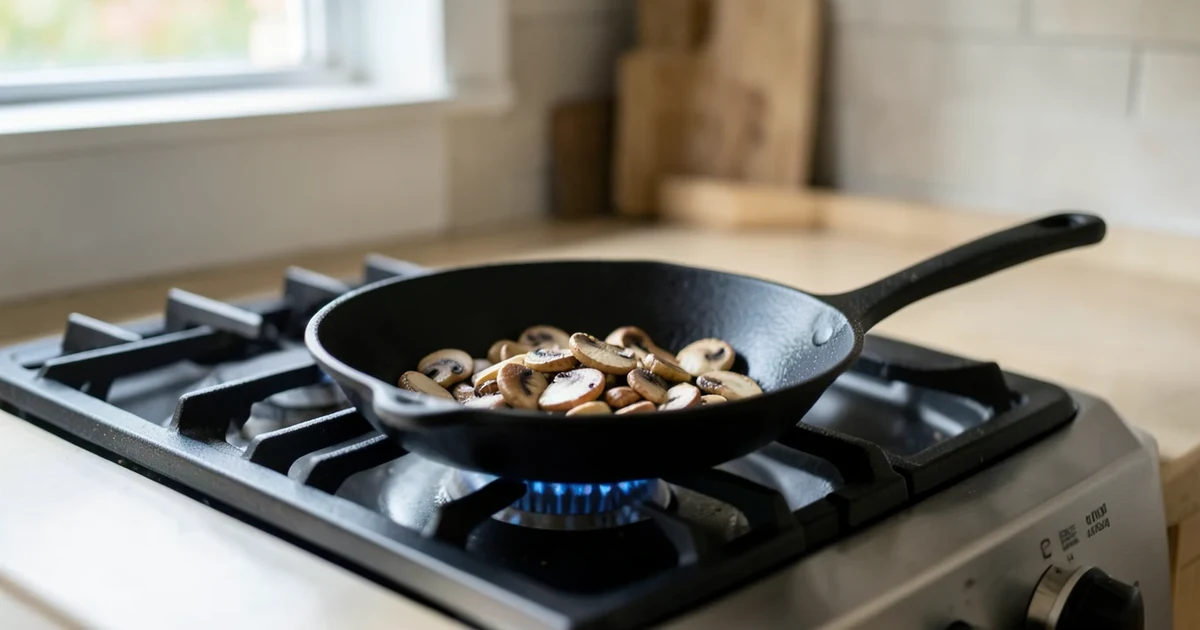
Cook thoroughly. Not a quick flash in a hot pan. Wild mushrooms want a proper sauté until the water has come out and gone again.
Try a small amount first, with a new species, and wait a day. Individual sensitivity varies substantially and is not predictable. Eat only one new species at a time, so that a reaction can be attributed.
Keep a specimen of anything you eat, uncooked, in the fridge for 48 hours. If someone becomes ill, that specimen is what allows identification, and identification changes treatment.
Do not drink heavily with a new species. Alcohol interacts with several, and it also confuses the picture if something goes wrong.
Do not feed wild mushrooms to children, pregnant women, elderly people or anyone immunocompromised on a first try.
Do not mix a foraged collection into a dish without having identified every specimen individually. One misidentified mushroom in a pan contaminates the whole dish.
Storage
- Paper bags, not plastic. Plastic sweats and turns a collection to mush.
- Refrigerate and use within a couple of days for most species.
- Ink caps are the exception and must be cooked within hours — they dissolve.
- Drying works well for many species and concentrates the flavour. It does not reduce toxicity.
- Freeze cooked rather than raw for most species.
The thing that is not a rule
There is no test, no preparation and no rule of thumb that makes an unidentified mushroom safe. Not cooking, not peeling, not soaking, not boiling and discarding the water, not silver spoons, not whether insects have been eating it.
Identification is done species by species, on the features in the parts of a mushroom, and confirmed with a spore print. The kitchen comes after that, and it never substitutes for it.
If the identification is not certain, the mushroom is not food. That is the whole of the safety advice, and every other consideration on this page assumes it has already been satisfied.
Species referenced
Read this before anything else
- Never eat a wild mushroom identified by a website or an app.That includes this one. These tools narrow possibilities; they cannot see your mushroom, its base, its smell or its habitat, and the difference between a meal and a liver transplant is sometimes a feature buried in the soil.
- Get it confirmed in person by an experienced local forager or a mycological society. Most regions have one, most run free identification sessions, and they will look at the actual specimen.
- Dig, do not pull. The cup at the base of a death cap is often underground. Pulling the mushroom leaves the most important feature in the soil.
- If someone has eaten a wild mushroom and feels unwell, call poison control now — in the US, 1-800-222-1222. Do not wait for symptoms to worsen. Amatoxin poisoning has a false recovery phase, and delayed treatment is what makes it fatal. Save any uneaten pieces for identification.
Keep reading
- Mushroom Season: When Things Actually FruitFruiting tracks rain and soil temperature rather than the calendar. The rule of thumb is a good flush roughly a week to ten days after sustained rain.
- Mushroom Poisoning: Why the Delay Matters More Than the SymptomsHow long before symptoms start is the most informative single fact. Under six hours is usually the milder group; after six hours is the dangerous one.
- How to Take a Spore Print — and Why It Matters So MuchA spore print costs nothing, takes a few hours, and separates several deadly mushrooms from the edible species they resemble. Here is how, and what each colour rules out.