
Ink Caps: The One With the Alcohol Problem
By IdentifyThese Editorial · Reviewed · 3 min read
Two ink caps turn up in the same places at the same time. One is a well-regarded edible. The other contains a compound that makes drinking alcohol for several days afterwards a genuinely unpleasant experience.
The cap surface separates them at a glance.
Shaggy ink cap
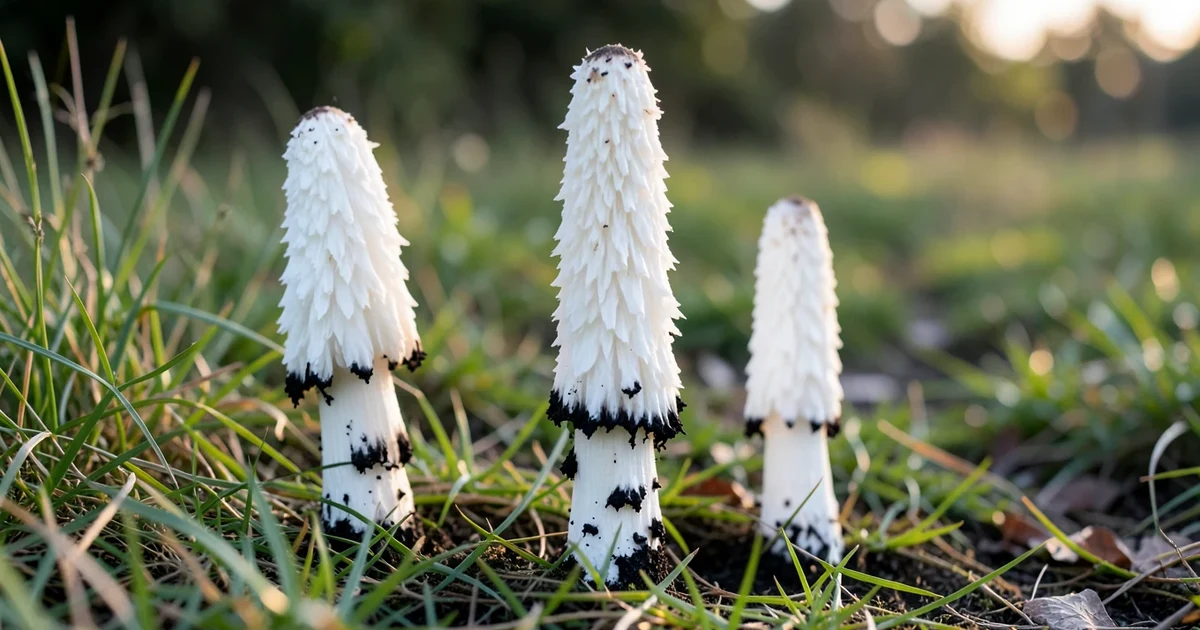
Coprinus comatus — the lawyer's wig.
- Tall and cylindrical, 5–15 cm, white, standing upright like a closed umbrella.
- Covered in shaggy upturned scales, which is what gives it the name and is the identifying feature.
- Gills white at first, then pink, then black.
- Deliquesces — it dissolves into black liquid from the cap margin upward as it matures.
- On lawns, verges, disturbed ground, wood chips, and along paths.
Considered a good edible when young and still white throughout. The critical constraint is time: it begins to dissolve within hours of picking, so it must be cooked the same day, and ideally within a few hours. This is not a mushroom to put in a fridge and deal with tomorrow.
Common ink cap
Coprinopsis atramentaria — the tippler's bane.
- Smooth or finely fibrous cap, not shaggy. Grey-brown, often with a hint of ochre.
- More egg or bell-shaped than cylindrical.
- Usually in clusters, often from buried wood.
- Also deliquesces.
It contains coprine, which inhibits the enzyme that breaks down acetaldehyde — the same mechanism as the drug disulfiram used to treat alcohol dependence.
If alcohol is consumed within a few days of eating it:
- Facial flushing and a sensation of heat
- Rapid heartbeat and palpitations
- Nausea, vomiting, headache
- Tingling in the limbs
- Onset within about 30 minutes of drinking
The effect can persist for up to several days after the meal, and it recurs on each exposure to alcohol during that window. It is unpleasant and frightening and usually self-limiting, though it warrants medical attention in anyone with cardiac disease.
The mushroom itself is otherwise edible, and it is eaten by people who simply do not drink for a few days.
Telling them apart
| Shaggy ink cap | Common ink cap | |
|---|---|---|
| Cap surface | Shaggy upturned scales | Smooth or finely fibrous |
| Shape | Tall, cylindrical | Bell or egg-shaped |
| Colour | White | Grey-brown |
| Habit | Often single or scattered | Usually clustered |
| Alcohol | No coprine | Coprine |
The shagginess is unmistakable once seen. A tall white mushroom that looks like a barrister's wig is the edible one.
The other ink caps
Mica cap (Coprinellus micaceus) — small, tawny, clustered on wood, with glistening mica-like granules on a young cap. Edible but slight, and reports of a coprine-like effect exist, so the same caution is reasonable.
Fairy inkcap (Coprinellus disseminatus) — tiny, in enormous swarms on and around stumps. Not worth eating.
The warning that matters more
Ink caps grow on lawns, and so do things that are not ink caps.
Destroying angel — pure white, on soil near trees, with white gills that stay white, a ring, and a cup at the base. It does not deliquesce and it does not have shaggy scales, and it is lethal.
Any white mushroom on a lawn deserves the check: dig it up, look for a ring and a cup, and see whether the gills stay white. The habit is in the Amanita check, and the species in the death cap.
Green-spored parasol — large, in lawns, often in rings, and one of the most common causes of serious gastrointestinal poisoning in North America. The spore print is green, which is the identifying feature, and it develops only as the mushroom matures — fairy rings covers where it turns up.
Why they dissolve
Deliquescence is a spore dispersal strategy. Most gilled mushrooms release spores into moving air; ink caps mature their gills from the bottom edge upward and dissolve the spent tissue as they go, so the spores drop clear rather than being trapped in a crowded gill space.
It is an elegant solution to a real problem and it makes the mushroom useless as food within a day of picking.
Species referenced
Read this before anything else
- Never eat a wild mushroom identified by a website or an app.That includes this one. These tools narrow possibilities; they cannot see your mushroom, its base, its smell or its habitat, and the difference between a meal and a liver transplant is sometimes a feature buried in the soil.
- Get it confirmed in person by an experienced local forager or a mycological society. Most regions have one, most run free identification sessions, and they will look at the actual specimen.
- Dig, do not pull. The cup at the base of a death cap is often underground. Pulling the mushroom leaves the most important feature in the soil.
- If someone has eaten a wild mushroom and feels unwell, call poison control now — in the US, 1-800-222-1222. Do not wait for symptoms to worsen. Amatoxin poisoning has a false recovery phase, and delayed treatment is what makes it fatal. Save any uneaten pieces for identification.
Keep reading
- Fairy Rings, and What They Are Telling YouA ring of mushrooms is the edge of a single organism expanding outward from a starting point. The dark green grass is the interesting part.
- Shelf Fungi: Turkey Tail and the Ones It Is NotTurkey tail has a pore surface, distinct concentric bands, and a flexible thin body. Three common lookalikes fail on one of those three.
- How to Take a Spore Print — and Why It Matters So MuchA spore print costs nothing, takes a few hours, and separates several deadly mushrooms from the edible species they resemble. Here is how, and what each colour rules out.