
Blossom End Rot Is Not a Calcium Deficiency
By IdentifyThese Editorial · · 3 min read
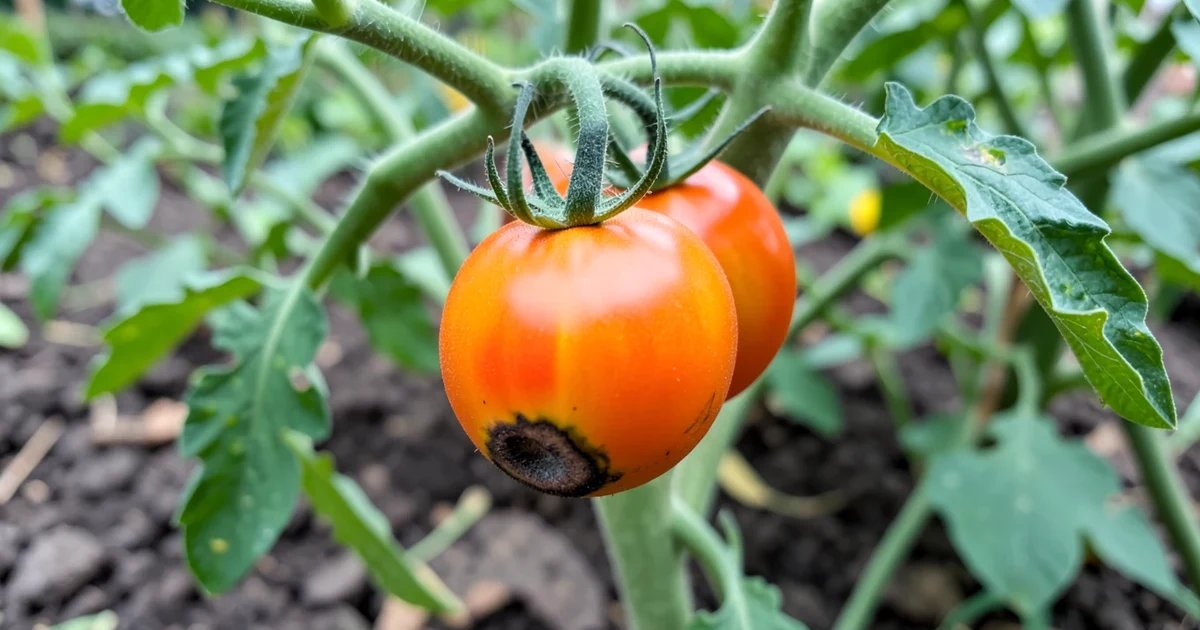
The dark sunken patch on the bottom of a tomato produces the same response every time: buy calcium. Crushed eggshells, powdered milk, gypsum, antacid tablets in the planting hole, calcium foliar sprays.
Almost none of it works, and the reason is that the diagnosis is wrong.
What is actually happening
Blossom end rot is a calcium deficiency in the fruit, in a plant growing in soil that has plenty of calcium. Those are different problems with different solutions.
Calcium moves through the plant in the transpiration stream — it travels with water, in the xylem, and once deposited it does not move again. It goes wherever water is going.
Leaves transpire hard. Fruit barely transpires at all. So fruit is always last in the queue, and during the two or three weeks when a fruit is expanding fastest, it needs more calcium than it can easily pull.
Interrupt the water supply during that window — a dry spell, a soaked week, root damage, a hot day after a cool one — and the fruit tissue at the far end from the stem does not get enough. Those cells collapse. That is the sunken patch.
By the time you see it, the damage happened two to three weeks earlier.
Why the fixes fail
| Remedy | Why it does not work |
|---|---|
| Crushed eggshells | Calcium carbonate breaks down over years, not weeks |
| Calcium foliar spray | Calcium does not move out of the leaf it lands on, and the fruit is not the leaf |
| Antacid tablets in the hole | Same problem as eggshells, plus it raises pH |
| Gypsum | Only helps if a soil test shows genuinely low calcium, which is uncommon |
| Epsom salts | Magnesium, which competes with calcium uptake — actively counterproductive |
The Epsom salts one is worth flagging because it is the most-repeated tomato advice on the internet and it makes blossom end rot slightly more likely rather than less.
What actually reduces it
Everything on this list is about steadying water.
- Consistent moisture. Even, deep, regular. Not a drought followed by a flood. This is the whole intervention.
- Mulch. 5–8 cm of straw, leaves or compost. Buffers the swing between waterings more than any amendment.
- Do not over-fertilise with nitrogen. It pushes leafy growth that outcompetes fruit for water and calcium. High-nitrogen feeds early in fruiting reliably make it worse.
- Avoid damaging roots. Cultivating close to the stem cuts exactly the fine roots doing the work.
- Containers need more attention. They dry fast and swing hard, which is why blossom end rot is far more common in pots than in beds.
- Choose varieties. Paste and plum types — San Marzano, Roma — are notably prone. Cherry types rarely show it at all.
The pattern that tells you it is settling itself
Blossom end rot on the first truss only, with later fruit clean, is the normal course of things. Early fruit sets while the root system is still small, and the plant grows out of it.
If it is still appearing in September, the water supply genuinely is not steady.
When to check the soil
A soil test is worth doing if:
- Blossom end rot is severe and persistent across a whole bed, over more than one season.
- The soil is very sandy, very acidic, or has never been tested.
- Peppers, squash and tomatoes are all affected equally.
Very low pH does limit calcium availability, and lime — which supplies calcium and raises pH — is the correct fix for that specific case. That is a soil-test decision, not a default.
It is not a disease
Nothing is spreading. It is not infectious, it does not persist in the soil, and no fungicide or bactericide has anything to do with it. Cut the end off and eat the tomato.
That distinction matters, because the reflex to spray a symptom is how gardens end up treated for things they do not have — the general argument in when not to spray. If the marks are on the leaves rather than the fruit, that is a different problem entirely: which tomato leaf spot is it.
Problems referenced
Check these two things first
- Push a finger into the soil, two knuckles deep. Wet soil plus a wilting plant means too much water, not too little — and it is the commonest reason a plant is dying. Dry soil plus crisp leaves means the opposite. The leaves look nearly identical either way, so the soil is what tells you.
- Turn a damaged leaf over. Half of all diagnoses live on the underside: fuzz means downy mildew, fine webbing means spider mites, clusters of insects mean aphids. Nothing on the top of a leaf is as informative.
Most garden problems are cosmetic and resolve without treatment. Reach for a spray last, not first.
Keep reading
- Which Tomato Leaf Spot Is It? Rings, Dots and GreaseFour diseases spot tomato leaves and they need different responses. Concentric rings, tiny black dots and a greasy texture separate them — one of them needs acting on today.
- Wilting Even Though You Watered ItA plant wilting in wet soil has a supply problem, not a water problem. Root rot, vascular wilt and stem borers each leave a different mark.
- Tiny Flies Around a Houseplant: Fungus Gnats, and the Two ImpostorsFungus gnats breed in the top few centimetres of wet soil. Which is why the fix is the watering, not the spray — and why sprays reliably fail.