
Wilting Even Though You Watered It
By IdentifyThese Editorial · Reviewed · 3 min read
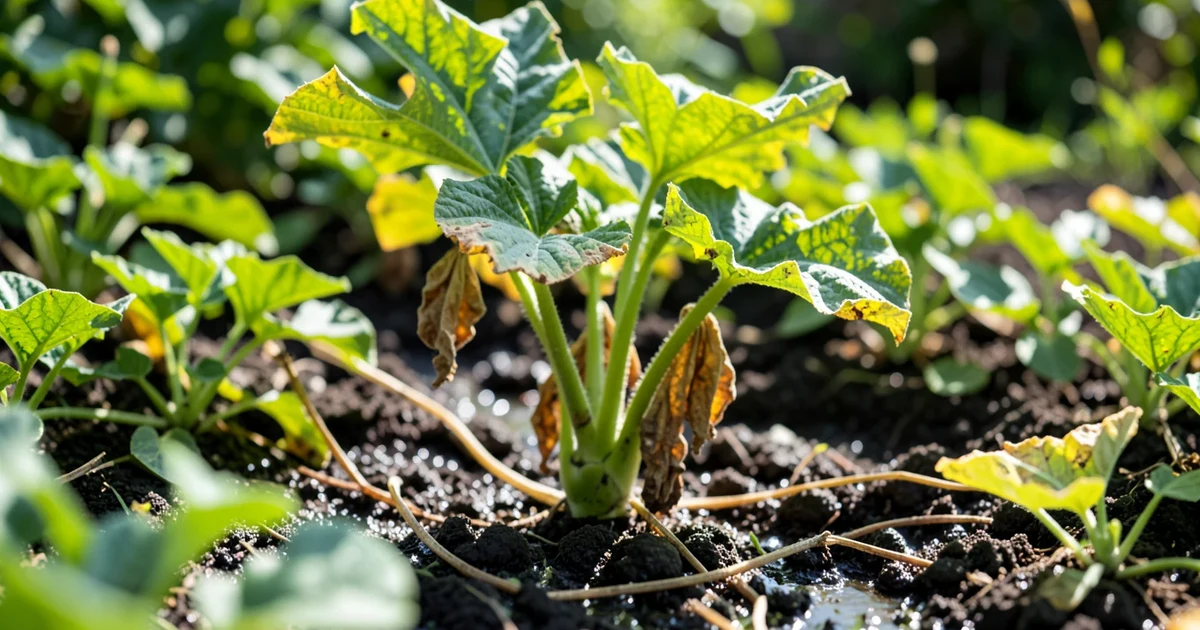
Wilting in dry soil is a watering problem. Wilting in wet soil is a plumbing problem, and adding more water makes it worse.
Four things cause it, and three of them can be told apart in about a minute with a knife.
First, confirm the soil is actually wet
Push a finger in to the second knuckle, or lift the pot. Surface moisture after a light watering is routinely mistaken for wet soil while the root ball underneath is bone dry — particularly in peat mixes, which repel water once they dry fully and let it run down the sides.
If the root ball is dry, that is the answer, and the fix is bottom-watering or a long slow soak rather than another cup on top.
Cut the stem
For anything woody or substantial, slice the main stem near the base and look at the cut face.
| What you see | Diagnosis |
|---|---|
| Clean white or green tissue throughout | Not a vascular disease — look at roots |
| Brown ring in the water-conducting tissue | Fusarium or verticillium wilt |
| White sticky threads when cut faces are pulled apart | Bacterial wilt |
| Hollow, with sawdust-like frass inside | Stem borer |
The bacterial wilt test is the satisfying one. Cut a wilted stem, hold the two cut surfaces together for ten seconds, then draw them apart slowly. If fine white strands stretch between them, that is bacterial ooze and the diagnosis is made. It is carried by cucumber beetles, so it turns up on cucurbits, and there is no treatment — remove the plant.
Fusarium and verticillium both discolour the vascular ring. Fusarium often works one side of the plant, so a tomato with one wilted branch and one healthy is a good candidate; it favours warm soil. Verticillium prefers cooler soil and tends to produce V-shaped yellow wedges on the leaf margins. Both live in soil for years, so the response is crop rotation and resistant varieties rather than anything applied this season.
Squash vine borer is the one people miss. A squash plant that wilts hard in the afternoon, recovers a little overnight, then collapses within a week, with a small hole and wet orange sawdust near the base, has a caterpillar inside the stem. Slit the stem lengthwise, remove it, and bury the wounded section under soil so it can root.
If the stem is clean, look at the roots
Slide the plant out or dig at the edge.
- Healthy roots are firm, pale and hold their shape.
- Rotted roots are brown or black, soft, and the outer layer slides off between finger and thumb leaving a thin central thread. There is usually a sour smell.
Root rot in a container is nearly always a drainage or frequency problem rather than a pathogen arriving from nowhere — see overwatering or underwatering for what actually distinguishes the two, since the leaves will not.
In the ground, look for a low spot, compaction, or a pan under the bed.
The causes that are not disease at all
- Transplant shock. A plant moved in the last week wilts because it has lost root contact. Shade it, keep it evenly moist, and wait — this one resolves itself.
- Heat. Large-leaved plants — squash, hydrangea, hosta — wilt at midday in full sun and recover by evening even in moist soil. Judge at 7am, not at 2pm.
- Root damage. Digging, cultivating too close, voles, or grubs eating roots.
- Girdling. A tie, a label wire or a wrapped root strangling the stem. Check the base.
- Salt. Heavy fertiliser draws water out of roots. White crust on the soil is the clue, and flushing is the fix.
What not to do
Do not water more. Do not fertilise — a plant that cannot move water cannot use nutrients, and salts make it worse. Do not repot into a larger pot, which increases the volume of wet soil around damaged roots.
If root rot is confirmed and some healthy root remains, the useful moves are trimming the dead material away, repotting into fresh mix in a pot barely larger than the remaining root ball, removing some leaf area to match, and then leaving it alone.
For anything with a brown vascular ring, the plant is not recoverable. The useful work is deciding what to plant there next year, and when not to spray applies directly: there is no fungicide for a wilt already inside the stem.
Problems referenced
Check these two things first
- Push a finger into the soil, two knuckles deep. Wet soil plus a wilting plant means too much water, not too little — and it is the commonest reason a plant is dying. Dry soil plus crisp leaves means the opposite. The leaves look nearly identical either way, so the soil is what tells you.
- Turn a damaged leaf over. Half of all diagnoses live on the underside: fuzz means downy mildew, fine webbing means spider mites, clusters of insects mean aphids. Nothing on the top of a leaf is as informative.
Most garden problems are cosmetic and resolve without treatment. Reach for a spray last, not first.
Keep reading
- Overwatering or Underwatering? The Leaves Won't Tell YouBoth make a plant droop and yellow, and the treatments are opposites. The soil, the leaf texture and the recovery time separate them in under a minute.
- Leaves Curling Up or Curling Down? The Direction Tells You WhyCurling upward and inward is usually water stress or heat. Curling downward and outward points at overwatering, root damage or herbicide. Direction narrows it fast.
- Seedlings Falling Over at Soil Level: Damping OffA seedling that topples with a pinched, water-soaked stem has damping off. It is not treatable once it starts, and everything useful happens before sowing.