

Seedlings Falling Over at Soil Level: Damping Off
By IdentifyThese Editorial · · 3 min read
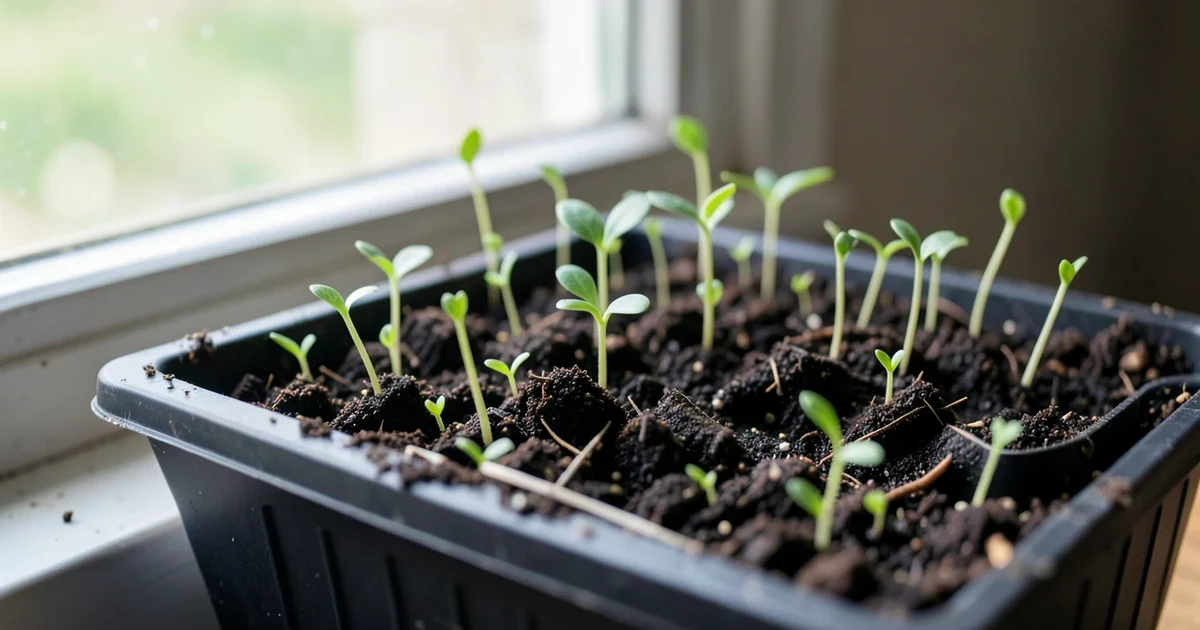
You water a tray of healthy seedlings in the evening and half of them are lying flat by morning, still green, still with their leaves attached, hinged over at the soil surface.
Look at the stem where it meets the compost. If there is a thin, dark, water-soaked constriction — as though it has been pinched — that is damping off.
What it is
Not one organism. A group of soil-dwelling pathogens — Pythium, Rhizoctonia, Fusarium, Phytophthora — that attack seeds and seedling stems before the plant develops enough structural tissue to resist.
Two forms:
- Pre-emergence, where the seed or shoot is destroyed before it appears. You conclude the seed was bad. Frequently it was not.
- Post-emergence, the visible version: the stem collapses at soil level and the seedling topples.
Once the stem is pinched, that plant is finished. There is no treatment. Everything worth doing is preventative, which is frustrating and also means it is entirely within your control.
The conditions it needs
All of these together, and removing any one of them breaks it:
- Consistently wet compost surface
- Poor air movement
- Cool soil relative to what the seedling wants
- Crowded sowing
- High organic matter with poor drainage
- Contaminated trays, tools or reused compost
Every one is a growing condition rather than an infection you catch. The pathogens are ubiquitous; what varies is whether the environment lets them win.
Prevention, in order of effect
Sow thinly. Crowding is the single largest factor. It blocks airflow at the soil surface, keeps humidity high exactly where the stems are, and lets the pathogen move plant to plant by contact. Thinning early feels wasteful and is the highest-return thing on this list.
Move air. A small fan on low, a few hours a day, aimed across rather than at the tray. It dries the surface, and it also produces sturdier seedlings — stem thickening in response to movement is real and measurable.
Water from below. Fill the tray, let the compost draw up, pour off the excess. The surface stays drier while the roots get what they need. Same principle that manages fungus gnats, and for the same reason.
Use fresh sterile seed compost. Not garden soil, not last year's used mix, not general-purpose compost with a coarse structure. Seed compost is low in nutrients and fine-textured deliberately.
Clean the trays. A ten-minute soak in dilute bleach or a hot wash. Reused modules carry last season's problem.
Remove humidity domes early. They help germination and become a liability the moment the seedlings are up. Take them off as soon as most have emerged.
Bottom heat. A propagation mat warms the compost, which speeds germination through the vulnerable window and favours the seedling over pathogens that prefer cool wet conditions.
Grit or vermiculite on the surface. A thin dry layer at the collar of the stem, the way a grit layer works against fungus gnats.
When it has already started
Act on the tray, not on the fallen seedlings.
- Remove collapsed seedlings and the compost immediately around them.
- Stop watering until the surface genuinely dries.
- Increase airflow immediately.
- Move the tray somewhere brighter and warmer.
- Prick out the healthy survivors into fresh compost, handling them by the leaves rather than the stem — a bruised stem is an entry point.
Fungicidal drenches exist and are largely a professional tool. In a home setting the conditions are the lever, and a drench applied to a tray that is still wet, crowded and still will not save it.
What else fells a seedling
- Cutworms cut the stem cleanly and the seedling lies beside a neat stump — no pinching, no discolouration. Dig a few centimetres down nearby and you will find the caterpillar. This is a chewing-damage problem, covered with the others in what is eating my leaves.
- Drying out produces a limp seedling that is limp all the way up, not hinged at one point.
- Fertiliser burn browns the stem base without the water-soaked look, on seedlings fed too early or too strong.
- Physical damage from watering with a heavy stream — use a fine rose or bottom-water.
The pinched, dark, water-soaked collar is specific. If it is there, it was damping off, and the next sowing is where the fix goes.
Problems referenced
Check these two things first
- Push a finger into the soil, two knuckles deep. Wet soil plus a wilting plant means too much water, not too little — and it is the commonest reason a plant is dying. Dry soil plus crisp leaves means the opposite. The leaves look nearly identical either way, so the soil is what tells you.
- Turn a damaged leaf over. Half of all diagnoses live on the underside: fuzz means downy mildew, fine webbing means spider mites, clusters of insects mean aphids. Nothing on the top of a leaf is as informative.
Most garden problems are cosmetic and resolve without treatment. Reach for a spray last, not first.
Keep reading
- Tiny Flies Around a Houseplant: Fungus Gnats, and the Two ImpostorsFungus gnats breed in the top few centimetres of wet soil. Which is why the fix is the watering, not the spray — and why sprays reliably fail.
- Drooping After Repotting: What Is Normal and What Is NotTransplant shock has a shape and a timescale. Most intervention makes it worse — here is what recovery looks like and when to actually worry.
- Wilting Even Though You Watered ItA plant wilting in wet soil has a supply problem, not a water problem. Root rot, vascular wilt and stem borers each leave a different mark.