

The Joro Spider: Large, Yellow, and Not a Threat
By IdentifyThese Editorial · · 3 min read
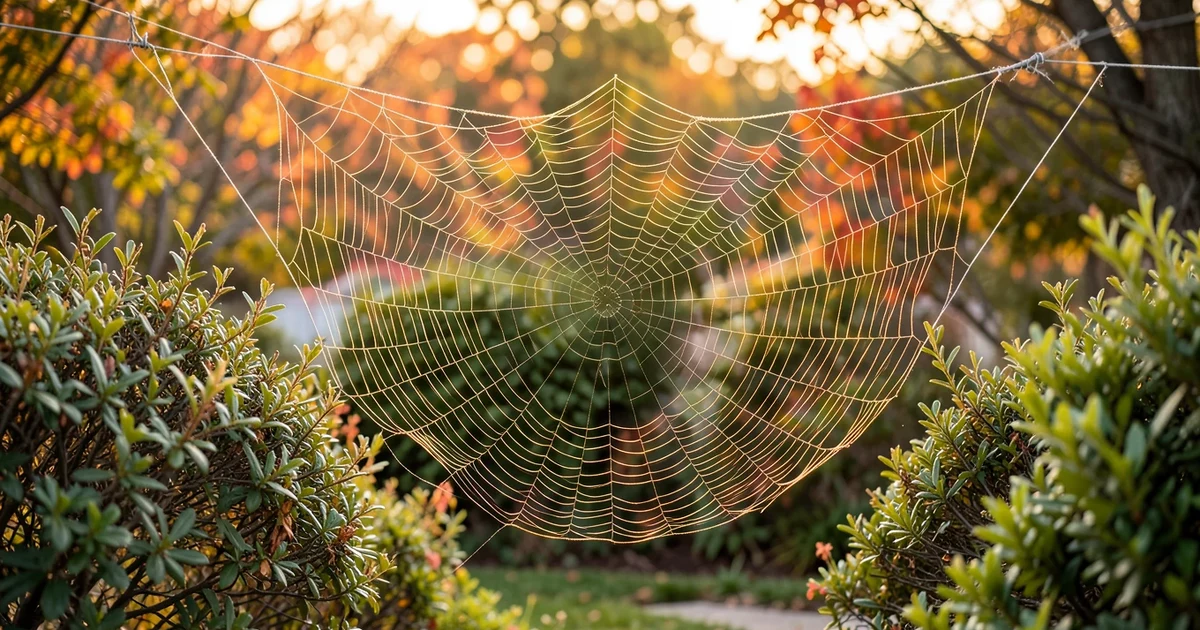
Trichonephila clavata arrived in Georgia around 2013, probably in shipping, and has been spreading through the southeastern United States since. It is large, it is brightly coloured, and its webs are conspicuous, which is why it gets a news cycle every autumn.
The coverage has been considerably larger than the animal warrants.
Recognising one
- Female body 17–25 mm, with a leg span that can reach 75 mm. Males are much smaller and drab.
- Bright yellow and blue-grey banding on the abdomen, with a red patch on the underside.
- Legs banded yellow and black.
- The web is golden, three-dimensional rather than a flat wheel, and can be a metre or more across with tangled barrier webs on either side.
The golden silk is the character that separates it at a glance from the native orb weavers. Golden silk orbweavers — Trichonephila clavipes, a related native in the deep south — also spin gold, and they are more elongated with prominent leg tufts.
The black-and-yellow garden spider, the other big showy orb weaver of the same season, sits in a flat white wheel with a conspicuous zigzag of thick silk down the middle. Different web, different animal.
Where it is
Established across Georgia, South Carolina, North Carolina, Tennessee and Alabama, with records spreading outward each season. Cold tolerance appears to be higher than the related southern species, which is the basis for projections of a wider range.
How far it will get is genuinely uncertain, and the confident maps in the coverage are extrapolations rather than observations.
The flying
Joro spiderlings balloon: they release silk threads and are carried on air currents, sometimes for long distances. This is completely ordinary spider behaviour and is how a very large share of spider species disperse.
Adults do not fly, do not parachute, and do not descend on cities. The story got there by taking routine ballooning and applying it to a spider the size of a hand.
Is it a problem
Genuinely unclear, and the honest position is that it is early.
Reasons to think not much: it eats insects, including some that are themselves pests; it builds in open air rather than displacing ground-dwelling species; and native predators including birds and wasps take it. Some work has found it has an unusually mild response to disturbance — it freezes rather than fleeing — which does not suggest a competitively dominant animal.
Reasons for caution: it reaches high local densities, and effects on native orb weavers in the same space have not been fully measured. Introduced species that seemed harmless for a decade have not always stayed that way.
What is fairly clear is that it is not dangerous to people, pets or property, and that killing them individually will not affect the spread.
Its bite
Like every orb weaver, it is not medically significant. The fangs are small relative to human skin and generally struggle to penetrate it. It retreats when disturbed.
Being bitten by one would require handling and persistence, and the result would be a brief local sting.
This is the general position for the whole orb weaver group — the large impressive spider in the middle of the large impressive web is the one you have least reason to worry about, which is one of the more useful things about identifying a spider by its web.
Why you see them in September
The same reason you see all the orb weavers then. They hatch in spring, grow all summer, and reach full size in late summer — at which point the webs and the animals become impossible to miss.
Then they lay egg sacs and die with the frosts. It is not an invasion arriving; it is a cohort finishing, and the same thing is happening with every native orb weaver in the same hedge — why there are suddenly spiders everywhere in autumn.
If you want it gone
Take the web down and it will usually rebuild somewhere else. Moving the spider by hand is not advisable for most people's comfort, but a broom and relocation works.
There is no reason to spray. The insecticide reaches the orb weavers, the pollinators and the predatory insects in the garden, and does nothing about the population in the county.
Species referenced
If you think you were bitten
- Most suspected spider bites are not spider bites. Studies of patients presenting with a “spider bite” repeatedly find that the large majority are bacterial skin infections — frequently MRSA — which need antibiotics rather than reassurance. A spreading, painful, pus-filled sore is far more likely to be an infection than a spider.
- Wash it, ice it, and watch it. Clean the area with soap and water, apply a cold pack, and keep an eye on it.
- Get medical care if the wound spreads or darkens, if you develop cramping, sweating, fever or severe abdominal pain, or if you are confident it was a widow or a recluse.
- Bring the spider only if it is already dead and to hand. Do not go looking for it. Doctors treat symptoms, not species.
In the US, the Poison Help line is 1-800-222-1222. This site is a reference, not medical advice.
Keep reading
- Identifying a Spider by Its WebWeb architecture is fixed by family, so the web identifies the group even when the spider is hidden. Four shapes cover almost everything you will find.
- Why There Are Suddenly Spiders Everywhere in AutumnThey are not coming in from the cold. The spiders in your house in September have been there all year, and they are moving because they are looking for mates.
- The Big Spider in the Garden Web: Orb WeaversThe large spider in the wheel-shaped web across your path is an orb weaver, it is harmless, and it will be gone by December on its own.