
Pine, Spruce or Fir? Start With How the Needles Attach
By IdentifyThese Editorial · Reviewed · 3 min read
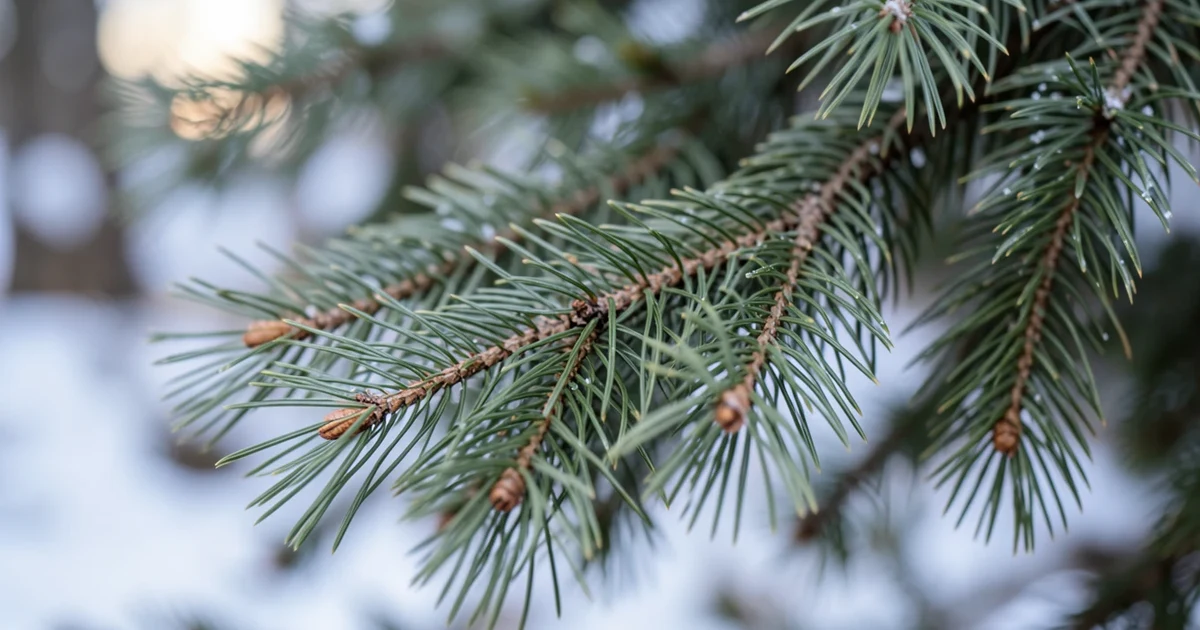
Three genera cover most of what people call an evergreen, and one look at how the needles attach to the twig separates all three. No key, no season, no flowers.
The one test
Pull off a needle-bearing section and look at the base of the needles.
- Bundled — two, three or five needles held together at the base by a small papery sheath. That is a pine, and nothing else does it.
- Single, and it rolls — each needle attaches individually. Take one between finger and thumb and try to roll it. A four-sided needle spins easily. Spruce.
- Single, and it will not roll — flat, two-sided, refusing to turn. Fir.
Spruce, fir, flat. It is worth remembering because the spruce–fir pair is where people actually get stuck; pine announces itself.
Confirming it
Once you have a candidate, a second character should agree.
| Pine | Spruce | Fir | |
|---|---|---|---|
| Needles | In bundles of 2–5 | Single, four-sided, roll | Single, flat, do not roll |
| Needle tip | Variable | Sharp, often painful | Blunt, often notched |
| Attachment scar | — | Raised woody peg left behind | Smooth round scar, flush |
| Twig feel | Smooth | Rough and bumpy, like coarse sandpaper | Smooth |
| Cones | Woody, persist on the tree, fall whole | Papery, flexible, hang down, fall whole | Upright on the branch, disintegrate in place |
The peg is the character to trust when the rolling test is ambiguous. Strip the needles from a short length of twig: a spruce twig is left covered in small raised woody pegs and feels distinctly rough. A fir twig is left smooth with flat round scars.
The cone character is close to conclusive if you can see cones. Fir cones sit upright like candles on the upper branches and fall apart scale by scale, so a whole fir cone on the ground is a rare find. Spruce and pine cones hang down and drop intact.
The ones that are none of the three
Several common conifers are not pine, spruce or fir at all, and they trip up the test.
- Hemlock — very short flat needles of noticeably uneven lengths, in flat sprays, each with two white stripes underneath and attached by a tiny stalk. Tiny cones, 1–2 cm. A drooping leader at the top of the tree is characteristic. Eastern hemlock is the giveaway of shaded ravines.
- Douglas fir — not a true fir. Flat needles, but the buds are sharply pointed and brown like a beech's, and the cones have unmistakable three-pointed bracts sticking out between the scales.
- Larch and tamarack — needles in dense clusters on short spurs, and deciduous. A conifer that turns gold and drops everything in November is a larch, not a dying spruce.
- Cedar, juniper, arborvitae, cypress — scale-like foliage pressed flat against the twig rather than needles at all. Juniper adds sharp juvenile needles on young growth and berry-like cones.
- Yew — flat needles like a fir, but soft, dark, and with a red fleshy aril instead of a cone.
Species, once you have the genus
Pines are keyed on how many needles are in the bundle:
- Five, fine and flexible, 8–13 cm — eastern white pine, the only native five-needle pine in the east
- Two, stiff, 5–15 cm — red pine, Scots pine, jack pine
- Three, long — pitch pine, loblolly, ponderosa in the west
Count the bundle. It is the fastest character in conifer identification.
Spruces separate on needle colour and cone size — blue spruce's stiff, sharply pointed blue-grey needles are unmistakable; Norway spruce has the largest cones, 10–15 cm and hanging.
Firs are largely northern and mountain trees in North America. Balsam fir's crushed needles smell strongly of the thing every scented candle is imitating.
Why it matters beyond naming
Pines drop needles that acidify soil slowly and make excellent mulch. Spruces are the standard Christmas tree that sheds; firs hold their needles far longer, which is what the price difference is for. And hemlock, the one that is none of them, is under sustained attack from an introduced adelgid across the east — worth being able to recognise before you plant or fell one.
For the broadleaf side of the same problem, start with opposite or alternate, and for a leafless tree of any kind, winter identification.
Species referenced
Start here: opposite or alternate?
Look at where the leaves join the twig. Are they in matched pairs directly across from each other, or staggered one after another? The vast majority of trees are alternate, so finding an opposite tree removes almost everything else in one step.
In North America, opposite-leaved trees are remembered as MAD Cap Horse: Maple, Ash, Dogwood, Caprifoliaceae (viburnums and elders), and Horse chestnut. That is very nearly the whole list.
Check partway along a healthy twig rather than at the tip, where crowding can make alternate leaves look paired. And check more than one twig.
Keep reading
- Identifying a Tree by Its BarkBark changes with age, which is why most bark guides fail. Work with texture, direction and colour under the surface rather than matching a photograph.
- Identifying Trees in Winter, With No Leaves at AllBark, buds, twigs and last year's fruit on the ground. Winter identification is not harder than summer — it just uses different characters, several of them more reliable.
- Maple or Sycamore? Look at the Bark, Not the LeafBoth have big lobed leaves and both are everywhere. The leaves are genuinely similar; the bark and the seeds are not, and either settles it in seconds.