
What Tree Did This Nut Come From?
By IdentifyThese Editorial · Reviewed · 4 min read
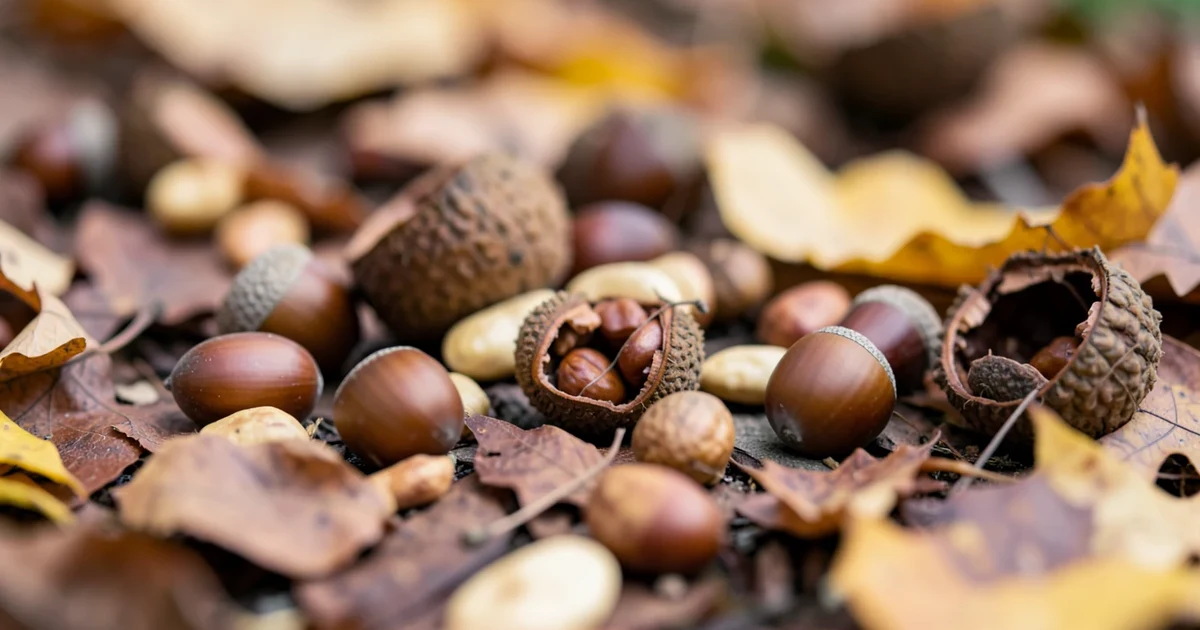
A nut is the most specific thing a tree drops. Leaves overlap between species, bark changes with age, and both disappear for part of the year — but a husk on the ground in October is a short, closed list.
Almost everything you will find in eastern North America is one of about a dozen things.
Start with the husk
What is around the nut narrows it faster than the nut itself.
| Husk | What it does | Tree |
|---|---|---|
| Cup on one end only | Sits like a beret; nut is the acorn | Oak |
| Thick green ball, does not split cleanly | Stains everything brown, strong smell | Black walnut |
| Four-part husk splitting along seams | Falls away, releasing a ribbed nut | Hickory |
| Spiny bur, splits in four | Contains 1–3 flat-sided nuts | Chestnut, chinquapin |
| Small prickly husk, splits in two | Two tiny triangular nuts | American beech |
| Leathery green husk, smooth | Single nut, thin shell | Pecan (a hickory) |
| Woody cone | Scales, seeds beneath them | Pine, spruce, fir |
Acorns
If there is a cup, it is an oak, and the acorn tells you which group.
- White oak group — cup scales knobby and warty, no fringe at the rim; nut matures in one season; much lower tannin, so squirrels cache them less and eat them first.
- Red oak group — cup scales flat and tight, often a fine fringe at the rim; two seasons to mature, so you will find both sizes on the same tree; markedly bitter.
Cup depth then helps with species. Bur oak's cup is enormous and deeply fringed, covering most of the nut. Pin oak's is a shallow saucer on a small round acorn. White oak's is a neat bowl about a third of the length.
This is the same split described by the leaves — rounded lobes versus bristle tips — set out in leaf shape, properly. Two characters, same answer, which is what you want.
Black walnut
The one people ask about most, usually phrased as "green tennis balls".
Fist-sized, green, hard, and it does not split neatly — it goes black and mushy instead. The smell is sharp and citrus-solvent. The juice contains juglone, which stains hands, clothes and concrete a brown that does not come out, so wear gloves.
Inside is a deeply corrugated dark shell that is genuinely difficult to crack. The kernel is excellent and quite unlike a shop walnut, which is a different species — English walnut, which sheds a thinner husk that splits cleanly.
Butternut looks similar but the nut is oblong rather than round and the husk is sticky and hairy. Butternut is also in serious decline from canker, so a find is worth reporting to a state forestry office.
Hickories
The husk splits along four seams and falls away in quarters, which distinguishes it from walnut immediately.
- Shagbark — thick husk, large pale nut, sweet. The tree's shaggy peeling bark confirms it from thirty metres.
- Bitternut — thinner husk with yellow winged seams; the nut is intensely bitter and inedible. The tree's sulphur-yellow buds are diagnostic year-round.
- Pignut — pear-shaped, husk splitting only partway, variable in taste.
- Pecan — thin-shelled, oblong, in the south.
Beech, chestnut and the spiny ones
American beech drops a small prickly husk holding two three-sided nuts, both small and sweet. Under a smooth grey trunk, that is a beech and nothing else.
A large, viciously spiny bur with flattened nuts is a chestnut. American chestnut was functionally eliminated by blight, so a mature nut-bearing chestnut in the east is most likely Chinese chestnut or a hybrid. Horse chestnut — the conker — is unrelated, has a husk with a few thick spines rather than dense ones, a single glossy round nut, and is not edible.
Cones
If it is woody with overlapping scales, it is a conifer, and the cone shape and size do most of the work.
- Long and slender, 10–20 cm, flexible scales — eastern white pine
- Small, round, prickly — spruce or a short-cone pine
- Tiny, 1–2 cm, hanging from a hemlock's fine flat needles — eastern hemlock
- Sitting upright on the branch and disintegrating in place rather than falling — true fir
Then confirm on the tree
A nut on the ground is not necessarily from the tree above it — squirrels move them, water moves them, and mowers throw them. Once the husk has given you a candidate, confirm on the trunk with bark or on the twigs with the winter characters.
Species referenced
Start here: opposite or alternate?
Look at where the leaves join the twig. Are they in matched pairs directly across from each other, or staggered one after another? The vast majority of trees are alternate, so finding an opposite tree removes almost everything else in one step.
In North America, opposite-leaved trees are remembered as MAD Cap Horse: Maple, Ash, Dogwood, Caprifoliaceae (viburnums and elders), and Horse chestnut. That is very nearly the whole list.
Check partway along a healthy twig rather than at the tip, where crowding can make alternate leaves look paired. And check more than one twig.
Keep reading
- Leaf Shape, Properly: Lobed, Toothed, EntireEvery tree key asks whether the margin is lobed, toothed or entire, and whether the leaf is simple or compound. Here is what those four words actually mean.
- Identifying a Tree by Its BarkBark changes with age, which is why most bark guides fail. Work with texture, direction and colour under the surface rather than matching a photograph.
- White Oak or Red Oak? The Lobes Have Points or They Do NotEvery oak in North America falls into one of two groups, and one character separates them. It holds for leaves, acorns and timber alike.