

White Fuzz on Houseplant Soil
By IdentifyThese Editorial · · 3 min read
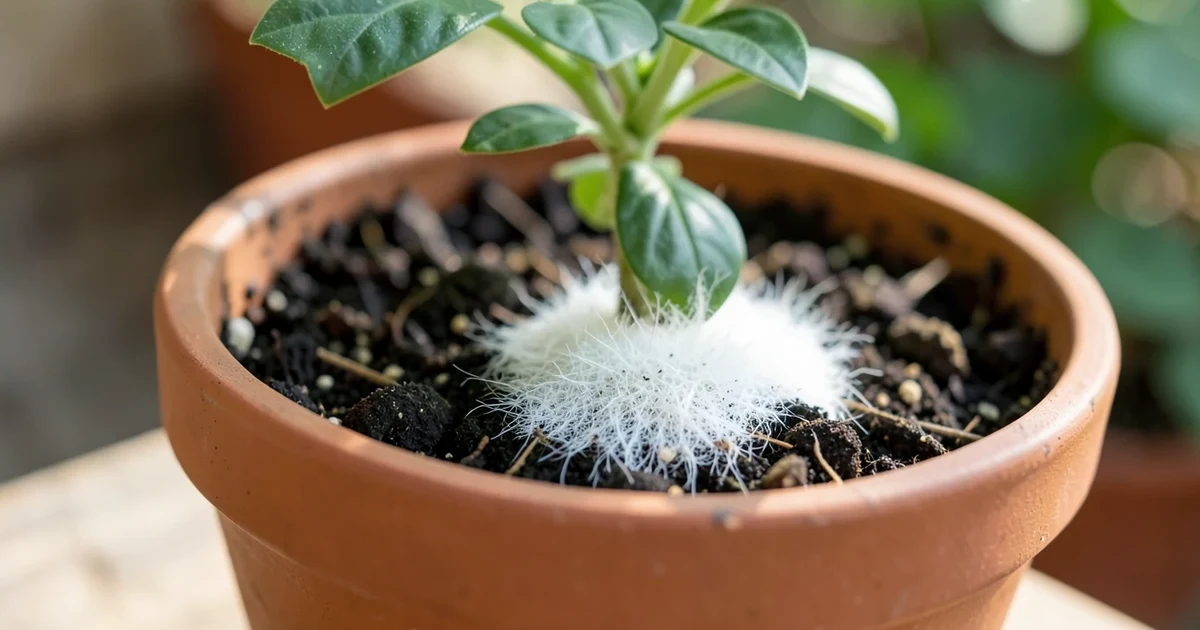
White fuzz on compost is a saprophyte — a fungus that eats dead organic matter. Potting compost is largely dead organic matter, so it is doing exactly what it evolved to do.
It is not attacking the plant. Nearly every case needs no treatment beyond a change in watering.
What it is telling you
Not that something is wrong with the plant, but that three conditions are being met at once:
- The surface stays damp between waterings
- There is little air movement over the pot
- Light levels are low
That combination is also what produces fungus gnats, and the two frequently arrive together, because they are two organisms responding to the same conditions. Fixing the conditions handles both.
What to do
- Scrape it off. Remove the top centimetre or two of compost. Do it outside or over a bin, because disturbing it releases spores.
- Let the surface dry between waterings. Water thoroughly, then wait until the top 3–5 cm are dry. This is better for almost every houseplant anyway.
- Increase airflow. Move the plant somewhere less still, or run a fan nearby occasionally.
- More light, within what the plant tolerates.
- Bottom-water — into the saucer, letting the pot draw it up. The surface stays dry while the roots drink.
- A layer of grit or coarse sand on the surface, which dries fast and gives spores nowhere hospitable to settle.
Cinnamon on the surface is widely recommended, has mild antifungal activity, and does nothing about the conditions. It is a garnish on the real fix.
When it does matter
Damping off in seedlings. Fungal pathogens in the same conditions kill seedlings by collapsing them at soil level. That is a different set of organisms and a genuine problem — the visible white growth on the surface is often the warning that the conditions have arrived.
Root rot. Compost that stays saturated long enough for surface mold is often also drowning the roots. Sour smell, yellowing lower leaves, and a plant wilting despite wet soil are the signs, and that is worth acting on quickly.
Immunocompromised occupants. Any indoor fungal growth is worth removing rather than tolerating in a household where that applies.
A hard white crust, not fuzz. That is not mold. It is mineral salt from fertiliser and hard water, and it means flushing the pot rather than changing the watering frequency — the same distinction between a deposit and a growth that runs through is it even mold.
The other things that appear on compost
- Yellow or orange slime mold — Fuligo septica, alarming, spreading, harmless. It appears overnight in warm damp conditions and often on mulch outdoors. Scoop it off if it bothers you.
- Small mushrooms, usually Leucocoprinus birnbaumii, a bright yellow one common in houseplants. It feeds on the compost, not the plant. It is not edible.
- Mycorrhizal fungi — deliberately added to some composts, white and thread-like, and beneficial. Distinguishable in that it is through the compost rather than fuzzy on top.
- Perlite, which is white and granular and is not alive at all.
Preventing it
- Use fresh compost, and store opened bags sealed and dry.
- Pots with drainage holes, and empty the saucer after watering.
- Do not use decorative pots without drainage as the growing container.
- Water on a schedule set by the compost rather than the calendar — check with a finger.
- Remove fallen leaves and spent flowers from the surface, which are the food source.
The general shape of it
Indoor fungal growth of every kind is a moisture problem before it is a fungus problem, and the organism is a symptom of a condition. That holds for a plant pot, a window reveal and a roof space alike — the material and the scale change, the requirement does not.
Which is why the useful question is not what species it is, but where the water is sitting and why — the reasoning that makes mold testing kits so much less useful than a hygrometer.
Types referenced
The species matters less than you think
- Public health guidance is to remove all indoor mold regardless of type. The CDC and EPA do not recommend routine species testing for ordinary households, because the response does not change: find the water, stop it, remove the growth.
- “Toxic black mold” is a marketing phrase, not a category. Stachybotrys is real and does need soaked material to grow, so finding it tells you something useful about your building. But the health effects that are well established — allergy, asthma aggravation, irritation — are not specific to it.
- Mold without water does not persist. Cleaning growth while leaving the moisture source is why it comes back. The leak, the condensation or the ventilation is the actual problem.
Call a professional for areas larger than about 10 square feet, for anything in HVAC ductwork, after sewage or flood water, or if anyone in the household is immunocompromised or has a lung condition.
Keep reading
- Mold on Wood FurnitureSurface mold on a finished piece wipes off. Mold on bare wood has gone into the grain, and the difference decides whether the piece is recoverable.
- Black Mold Around Windows: It Is CondensationMold on a window reveal is the coldest surface in the room collecting the room's moisture. Cleaning it treats the symptom; three changes treat the cause.
- A Musty Smell With No Visible MoldThe smell is real and it means active growth somewhere. Here is the search order, and the six places hidden mold is usually found.