

There Is a Fossil in My Rock. What Now?
By IdentifyThese Editorial · · 4 min read
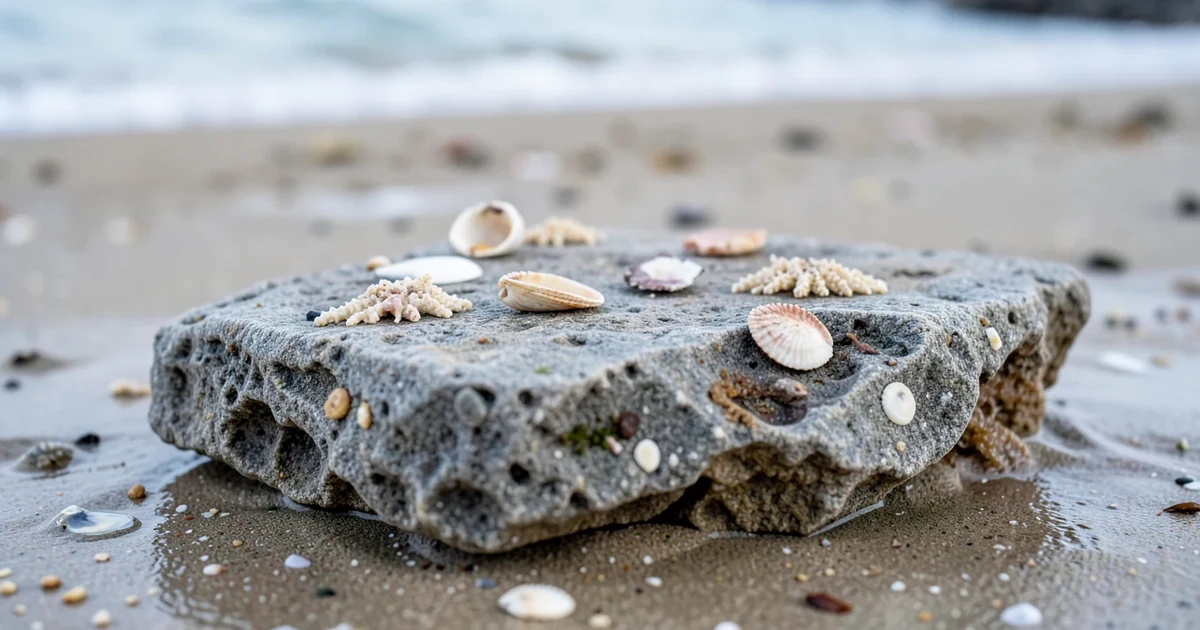
Most fossils found by accident are common marine invertebrates from rocks that are full of them. That is not a disappointment: a limestone bed packed with brachiopods and crinoid stems is a snapshot of a seafloor, and it is legal to collect nearly everywhere with permission.
The part worth getting right is the small fraction that is different.
Is it actually a fossil?
Several natural patterns imitate fossils convincingly.
Dendrites are the most common false positive by a wide margin — black, branching, fern-like patterns on a rock surface, formed by manganese oxide crystallising along a crack. They look exactly like a fossil plant. The difference is that a dendrite has no cellular structure, no stem with a consistent thickness, and it fades into the rock rather than sitting in it.
Concretions form around a nucleus and produce spheres, discs, and shapes that read as eggs, bones, turtles or artefacts. They are the single largest source of misidentified fossils.
Liesegang bands are concentric rings of iron staining that look like growth rings.
Cone-in-cone structure is a fibrous calcite texture that resembles coral or bone.
Real fossils show biological organisation: repeated units of consistent size, bilateral or radial symmetry, chambers, segments, ribs at regular intervals, a growth direction.
The common finds
| Fossil | Looks like | Where |
|---|---|---|
| Crinoid stems | Stacks of tiny discs or "Cheerios" | Limestones, extremely abundant |
| Brachiopods | Two-part shells, symmetric across the middle | Marine limestone and shale |
| Bivalves | Two-part shells, symmetric between the halves | Marine and freshwater |
| Corals | Honeycomb or horn shapes | Limestone reefs |
| Bryozoans | Lacy or twiggy encrusting networks | Limestone |
| Trilobites | Three-lobed segmented arthropods | Cambrian to Permian shales |
| Ammonites | Coiled, chambered, with sutures | Mesozoic marine rocks |
| Plant impressions | Bark patterns, leaves, stems | Coal measures |
| Shark teeth | Triangular, enamelled, with a root | Marine sands and gravels |
The brachiopod versus bivalve distinction is worth knowing. A brachiopod's two valves are different from each other but each is symmetric down its own midline. A bivalve's two valves are mirror images of each other and each one is asymmetric. Draw the line of symmetry: through the shell means brachiopod, between the shells means bivalve.
The legal line
This is the part that matters and it is genuinely different for different material.
Invertebrates and plants — on private land with the landowner's permission, generally yours. On US federal land managed by the BLM or Forest Service, reasonable amounts may be collected for personal use without a permit, non-commercially. National Parks prohibit all collecting.
Vertebrate fossils — bones, teeth, jaws, anything with a backbone — are treated entirely differently on US federal land. The Paleontological Resources Preservation Act of 2009 makes collecting them without a permit illegal, and permits go to qualified researchers depositing material in public repositories. This applies whether or not the specimen looks important, and whether or not you knew.
On private land in the US, vertebrate fossils generally belong to the landowner. Other countries differ sharply — many, including much of Europe, China, Brazil and Mongolia, treat all significant fossils as state property regardless of where they were found.
The practical rule: if it has a backbone and you are not certain of the land status, photograph it, record the location, and leave it.
Why context is the valuable part
A fossil removed from its bed loses most of its scientific value, because the information is in the association — which layer, which other species, which orientation, which formation.
If you find something that looks unusual, before you extract it:
- Photograph it in place, with something for scale.
- Record the exact location. A phone's GPS is enough.
- Note the rock type and any layering.
- Contact a local university geology department, a state geological survey, or a natural history museum.
Museums are generally pleased to hear from people and will tell you quickly whether something is common. Most of the time it is, and you keep it.
Getting it out and looking after it
If it is legal and it is worth collecting:
- Take the surrounding rock with it. Trimming later is easier than repairing a break.
- Wrap in newspaper; label immediately with locality and date. Unlabelled specimens are ornaments.
- Clean gently with water and a soft brush. Avoid acids — many fossils are calcite, and so is the limestone around them, so acid removes both indiscriminately.
- Watch for pyrite. Pyritised fossils can decay in humid storage, crumbling and producing sulphuric acid. Keep them dry.
The distinction between the fossil and the rock holding it is worth being clear about before you start work on either — rock, mineral or neither sets out why the two need different treatment.
Mineral pages referenced
Keep reading
- Rock, Mineral, or Neither?A mineral is one substance with one composition. A rock is an aggregate of them. And a great deal of what gets brought in for identification is neither.
- A Rock With Crystals Inside: Geodes, Vugs and What They Are WorthA hollow lined with crystals is a geode; an irregular cavity in solid rock is a vug. Both form the same way, and neither is usually worth money.
- Is My Rock Valuable? An Honest AnswerMost rocks are worth nothing, and that is fine. Here is what actually creates value in a specimen, the handful of finds worth pursuing, and how to get a real appraisal.