

What to Do Before You Ask Anyone to Identify a Rock
By IdentifyThese Editorial · Reviewed · 4 min read
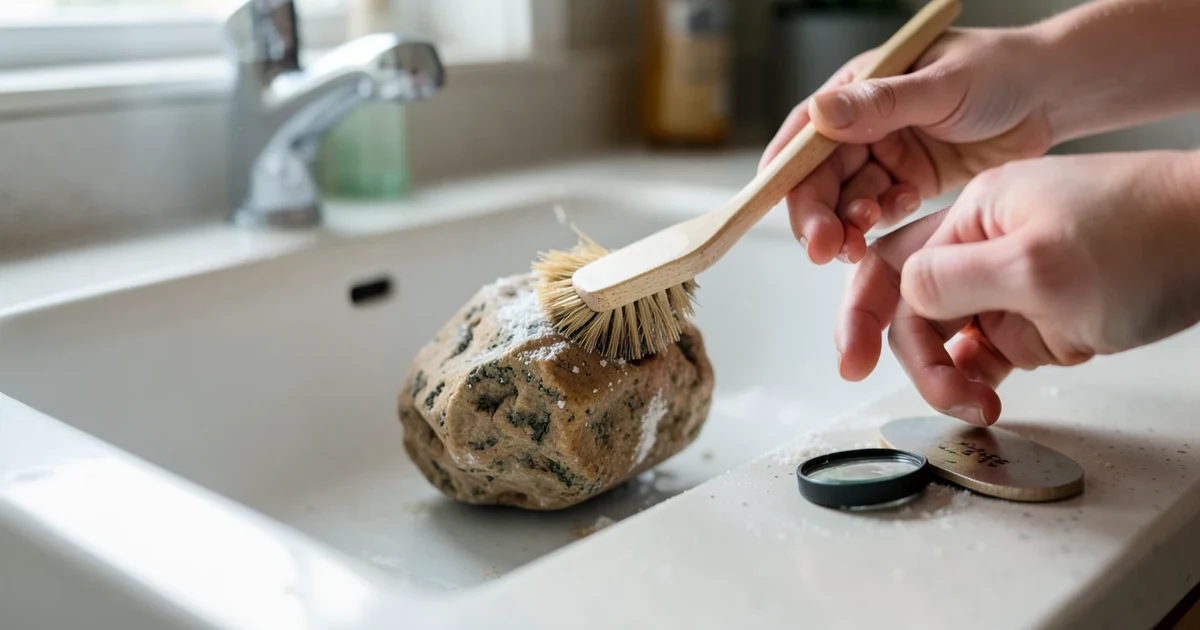
Most identification requests cannot be answered, and it is almost never because the rock is mysterious. It is because the photograph shows a wet weathered surface in dim light with nothing for scale, and the sender has not run any test that would take under a minute.
Twenty minutes of preparation converts that into a question with an answer.
Wash it
Scrub with water, a stiff brush and washing-up liquid. Get the soil out of the crevices.
Do not use acid, and do not use a wire brush, which leaves metal streaks that then get reported as a metallic mineral.
Break it
This is the step people skip, and it is the one that matters most. The outside of a rock is a weathering rind — oxidised, stained, coated in lichen, and chemically unlike the inside. Colour, lustre, grain size and crystal structure are all on a fresh surface.
Wrap it in cloth, put it on a hard surface, wear eye protection, and strike it with a hammer.
If it is a display piece or something you want intact, chip a small area on an inconspicuous face instead. Even a fingernail-sized fresh patch is far better than nothing.
Run the four tests
Each takes under a minute and each eliminates a large group.
- Streak — the unglazed back of a ceramic tile. Powder colour is far more consistent than surface colour. The streak test has the method and the cases where it is decisive.
- Hardness — fingernail (2.5), copper coin (3.5), steel nail (5.5), glass (5.5), steel file (6.5). The Mohs test at home covers doing it without damaging the specimen.
- Magnet — a fridge magnet, then a stronger one.
- Acid — a drop of vinegar. Fizzing means a carbonate, which is how calcite is separated from quartz in about two seconds.
Also note the weight for its size. "Heavier than it looks" is genuine information and it is the first thing that separates metallic ores from everything else.
Take four photographs
In daylight or under a bright neutral lamp, never with flash, which flattens texture and blows out lustre.
1. The fresh broken surface, filling the frame, with a coin beside it. This is the important one. A scale object is not optional — without it a photograph is uninterpretable, and a hand or a finger is not a scale.
2. The whole specimen from a normal viewing distance, dry.
3. A close-up of anything distinctive — a crystal face, a vein, a banded section, an unusual texture. A phone macro or a hand lens held over the lens works.
4. The streak on the tile.
Photograph it dry. Wetting a rock makes it look better and hides the texture, the true colour and the lustre. If you must show both, take one of each.
Write down what you know
The context often settles it when the specimen alone cannot.
- Where it came from — the state or county at minimum. Geology is regional; the local formation narrows the list enormously.
- The setting — riverbed, beach, roadcut, ploughed field, mine spoil, construction site, garden.
- Whether it was loose or in place. A rock still attached to bedrock tells you the formation. A loose cobble may have travelled a long way, especially in glaciated country.
- What is around it — the local bedrock, other rocks with it.
- Rough size and weight.
A construction site and a riverbed produce different answers for identical-looking rocks, and mine spoil heaps produce things that occur nowhere else nearby.
Rule out the manufactured
Before asking anyone, check whether it is a rock at all. Slag, concrete, clinker, brick, furnace glass and asphalt account for a large fraction of identification requests, and none of them have a geological name.
The signs: rounded gas bubbles, a glassy fracture, unnaturally bright colours, a flat cast surface, embedded angular aggregate, or being far too light or far too heavy for its appearance. Rock, mineral or neither works through the third category, and it is the answer more often than people expect.
Then ask
With a clean fresh surface, four photographs, a streak result, a hardness bracket, a magnet result, an acid result and a locality, most rocks can be identified by someone who knows the region.
Without those, almost none can — which is why the answer to a bare photograph is so often a polite guess. State geological surveys, university geology departments and local lapidary clubs will all look at a well-prepared specimen, and the last of those is the most likely to have handled the exact thing you are holding.
Mineral pages referenced
Keep reading
- What Is This Black Shiny Rock?Eight things account for nearly every shiny black rock. Streak colour, weight and how it breaks separate all of them in about two minutes.
- The Streak Test: The Most Underused Tool in IdentificationThe streak test takes five seconds and settles questions that colour cannot. How to do it properly, what each streak colour narrows to, and when it will not work.
- There Is a Fossil in My Rock. What Now?Most fossils people find are common invertebrates worth keeping and not selling. Vertebrate material is different, legally and scientifically — here is the line.